It’s World Cup year, the England women’s team won the Euros and despite the cost of living issues all around us, football seems to be booming.
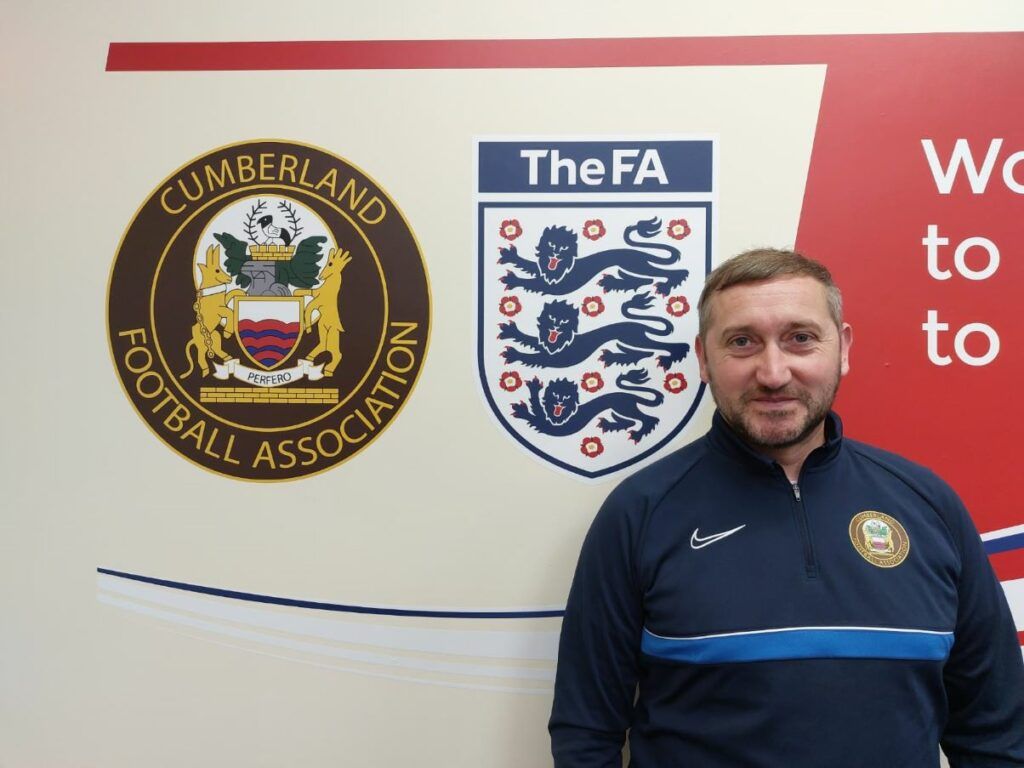
But what’s it like at grassroots level? An appropriate time to catch up with Ben Snowdon, chief executive of the Cumberland FA.
Ben, just to start with, can you tell us a bit about your football background?
I can but there isn’t that much to tell. I come from Boldon in the North East, but my mother is from Cumbria and St Bees was always my home from home.
I am part of a footballing family and so had little choice other than to get involved within the game. My grandfather was an ex professional at Derby County and Swindon, my dad played for a number of teams including Bishop Auckland and both of my uncles played football within local leagues.
From an early age I spent my Saturdays watching SC Vaux (the team Nigel Saddington – ex-Carlisle captain – played for before Sunderland), a team my father co-managed, in the Wearside league.
In terms of playing my first taste of the game was towards the end of primary school. I then started to play for Redby CA in Sunderland, but I think I knew fairly early that I wasn’t going to be a professional footballer.
I loved everything about football when I was old enough to go on my own, and then with my uncle, I was always on the Fulwell End at Roker Park watching Sunderland or at Brunton Park, when visiting family, with my great uncle watching Carlisle United.
At 16 I took a B-Tec national diploma in sports studies at South Tyneside College, and during this course I was given a chance to take the old FA Preliminary Coaching award and was shocked when I passed it.
This was my first step in coaching and I started to work for Durham County FA and others on summer coaching camps, before leaving to start a Sports Science Degree at Staffordshire University, where I continued to play.
Upon finishing my course I gained my first job at West Cumbria College as a sports lecturer. This saw me playing within local leagues for St Bees on both a Saturday and Sunday, and other than a couple of seasons at Windscale AFC, I stayed with St Bees until I had my boots hung up for me in my early 40s.
I then helped run a Sunday League team and I now coach an Under-10s girls team and help with an Under-13s team at the club.
When I had just moved across to the area, I started doing some work for Cumberland FA and when, after moving to Newton Rigg to be part of their football programme, I decided to leave teaching I took on the role of football development officer at the county.
I then moved on to lead the football development team (as county development manager) and then stepping into the very big shoes of Geoff Turrell when he retired, to become the chief executive officer, where I have been for the last 12 years.
When did you decide to move into the administrative side of the game and what is your role as CEO?
I still don’t think I have actually made the decision to move into the administrative side of the game, I still secretly think I could do a job for Sunderland at left back.
In all honesty I was lucky enough to be presented with a number of opportunities and this good fortune, along with a real desire to be involved within the world of football in some capacity, have mapped out my career path for me.
My job as CEO of Cumberland FA is multi-faceted in that I look after the organisation as a business, oversee the governance of the game (rules and regulations) and manage a brilliant team of staff who are very much working together to make a difference in the game we love.
However, in a nutshell everything we do is with the view of getting more people involved in the game within a safe, inclusive and positive environment.
There were doom merchants predicting the collapse of numerous clubs in the pandemic of 2020. How has Cumbria fared?
The pandemic was so much bigger than football and I know that it obviously had a dramatic impact on lots of people and families, and we are obviously continuing to see the fall out and still do not fully know the impact that this period of time will have had on society, specifically young children.
In the face of the pandemic there was community, support and hope and nowhere were these characteristics demonstrated more than within our grassroots game, as football underlined its importance to and within the local community.
Mental Health and Wellbeing has quite rightly been a key focus for a lot of people and after periods without the game we believe that there is greater understanding of the benefits that organised sport has upon these areas and it is important that we harness the undoubted power of football to, as The FA state in their strategy “Unite communities and improve the health of the nation.”
My favourite quote about football from that time was from Jurgen Klopp who said football was the most important of the least important things.
Here, in Cumbria we are used to adversity and facing huge challenges to the game. We have had foot and mouth and major floods that have all stopped the game for a large period of time and we have, to use a Peter Crouch quote, come back stronger.
In a way I think it actually made us appreciate the importance of the grassroots game within the community and within our own lives. A type of scenario – ‘you don’t know what you have until its gone.’
As a county we were well aware that there would be challenges to clubs who had not been able to bring in revenue during lockdown and restrictions.
So, backed by our board of directors and led by our chair Fred Conway, we provided all of our teams with free affiliation and insurance for two seasons and our referees with free registration for a season.
Overall we have seen a small reduction in the number of teams, but a growth in the number of people playing the game which is testament to the outstanding work that is undertaken by leagues, clubs and the referee workforce within the county.
However we are now facing the, some would argue, even greater challenges that the cost of living crisis could potentially have upon the non-elite game as families and players have less disposable income and clubs are facing rises in fees, services, transport etc.
As a county FA we recognise this and have not raised our own affiliation fees again this year and are working on a package of support to junior and adult clubs that focuses on supporting them with course fees etc.
Of course it is still Cumberland FA, not Cumbria. Which areas do you cover?
Yeah The FA boundaries still have Cumberland and Westmorland, which are obviously now also being used following the recent restructuring of the county council, although we are more historic.
At Cumberland we cover from Seascale and Gosforth and then the rest of the Copeland Borough (Millom and Barrow are part of Lancashire FA). We then have Allerdale, Carlisle in the East and then it’s really just up to Penrith in the North, before you are in Westmorland.
The England triumph at the Euros was a big boost for the women’s game. Has it been felt in Cumbria?
It was certainly felt in my household as I was lucky enough to attend with my eight, now nine-year-old daughter, who plays football and is part of a generation who is standing on the shoulders of all those who battled before her so that she can realistically aspire to be professional footballers.
It was also a very emotional day for my family, as my father had directly coached two of the lionesses squad players during his time at Sunderland, in Jill Scott and Demi Stokes, and Lucy Bronze had come through his college.
Unfortunately he has advanced dementia and so what should have been one of his proudest days was taken away from him due to his illness.
In terms of the impact locally then thanks to our clubs and the volunteers the women and girls game has never been in a better position and has more than doubled over the past few seasons as the game continues to naturally grow and the success and increased public profile of Lionesses and the women’s game in general.
Our challenge now is to continue to enhance and diversify the player pathway to best meet players needs with a view of growing the game.
We need to ensure we have a variety of playing opportunities to retain, attract and re-engage participants to the game. Ultimately we need to ensure that females have the same access opportunities in football both recreationally, educationally and competitively.
The fact that Georgia Stanway had previously played at the Cumberland FA Centre of Excellence also demonstrates that we have talent within this area and we need to work with The FA Nationally to ensure that there is a clear route for talented players from the area to access elite clubs and aspire the next generation.
Youth is the future of any sport, so how is that developing and progressing across our FA region?
One of the age groups who were negatively impacted the most by COVID was our younger age groups who have clearly not had a smooth introduction to the game.
However, despite this our youth football at the younger age groups continues to grow. As a County we have always recognised the importance of entry level of football and that in order to sustain and grow something you need to build it upon really strong foundations.
We have therefore worked really hard with our three youth leagues to support them in providing a positive first experience of football within their leagues.
This work, and the continued popularity of the game within this country, appears to be paying dividends as we have continued to see teams retaining good numbers throughout mini soccer/development football and into the competitive age groups at U12 and above.
However it would be remiss of me to not say that we are facing a huge challenge in youth football with regards to behaviour both on, but mainly off the pitch.
This is a huge focus for us this season as we need to see a distinct improvement in this area of the game as we ourselves, clubs, but mainly individuals, have to start to take responsibility for unacceptable behaviour.
It is clear that the majority of our games go without incident and that the majority of the people are good and positive. We are dealing with a small, vocal minority.
So its time for the majority to stand up to this minority and say that enough is enough and ensure that the environment that their child plays within in a positive one in which they can thrive.
Other sports, particularly cricket and both codes of rugby, struggle to retain players after they finish Under-16s. How are you faring at the Cumberland FA and what do you do to help stop this?
There undoubtedly is a drop off in football from around U13/U14 and above and this is for a number of reasons.
Some of these are societal e.g. more choice, need for seasonal work, going away to university etc., whilst other are more unique to football, and these are obviously the ones that we try to address through listening to the players and the clubs and trying to support leagues to provide solutions through the structure and formats of football that are provided.
This offer is only possible through improving and increasing facilities.
Whilst it is a continuous challenge, there are now U17/U18s leagues in Carlisle, the West and in Westmorland (where a couple of Carlisle/Penrith based teams play).
There has also been work with the adult leagues to try and ensure the smooth transition of youth clubs into these leagues and we have seen numerous examples of clubs who have transitioned from U16 or U18 football into Saturday or Sunday leagues, and have had success.
Ultimately though it is down to the hard work of individuals from clubs who drive this area of work and ensure that they create clubs and teams where these players continue to want to be involved that makes the biggest impact.
Are there still County Championships and National Knockouts for age group sides, and how have we been faring?
During COVID the FA cut funding into county FAs due to a reduction in its own income due to loss of revenue from the use of Wembley, commercial deals etc.
On top of this the FA also rolled out a new funding formula, which is based on a market share. Both of these reductions in central funding have led to some difficult decision being made by County FA’s who have had to undertake a cost v benefit v saving analysis to identify opportunities to increase revenue, as well as establishing potential costs efficiency savings.
As a County FA we will see the CFAs central FA funding reduced by 25.12 per cent, which was the largest reduction within all County FAs.
Unfortunately one of the areas that a number of counties chose to cut was their U18 representative side and this left both the National and Regional competitions without enough teams to participate.
This, on top of the proposed cost of travel to ourselves as a rural county, meant that we just could not continue the team at this time.
As a company we have always put football first and have used this strategy to put ourselves in the best position to deal with this loss through the development of a long-term investment plan and the use of balanced annual Budgets and cost controls.
Financially we must find the right balance between supporting the grassroots game and ensuring we remain solvent as a business and so we hope that in the future this will return.
You were involved in suggesting an amalgamation of Workington and Egremont Sunday Leagues recently. How has that progressed?
The suggestion of an amalgamation was very much down to the clubs from within the Workington and Egremont Sunday leagues and I think is more based around the situation both leagues currently find themselves in, in terms of the number of teams in both leagues and the desire to try something new.
Our role, as the county FA, is more in a facilitating capacity in looking into the feasibility and practicality of such a move.
We have held initial talks with representatives from both leagues and will be consulting with clubs, whose decision it will ultimately be as to whether there is a new league formed or not, to establish their thoughts on a number of critical issues.
However, from initial feedback we really do believe that there is a desire for this to succeed and a hope that this may reinvigorate Sunday football within the west of the county.
If a generous benefactor left £1 million to Cumberland FA what would you recommend it is spent on?
The way the pound is currently going and the increasing costs we are facing, it maybe just about enough to get some new footballs, bibs and a set of cones.
In all seriousness the rising costs does mean that a million pounds no longer yields the same impact as it would have a few years ago.
From a conventional sense, facilities are always pivotal to grassroots football and improving these and the infrastructure around them continues to be a priority for us at the CFA, and would ensure that football locally can continue to grow.
This includes having the right mix of artificial and grass pitches, which are designed with local weather and our changing global environment in mind, and optimising Investment to maximise maximising any return of investment.
Away from football I would, for very personal reasons, happily split the money between research into dementia and also with Gary McKee, who we recently sponsored, and who is a true inspiration to us all.