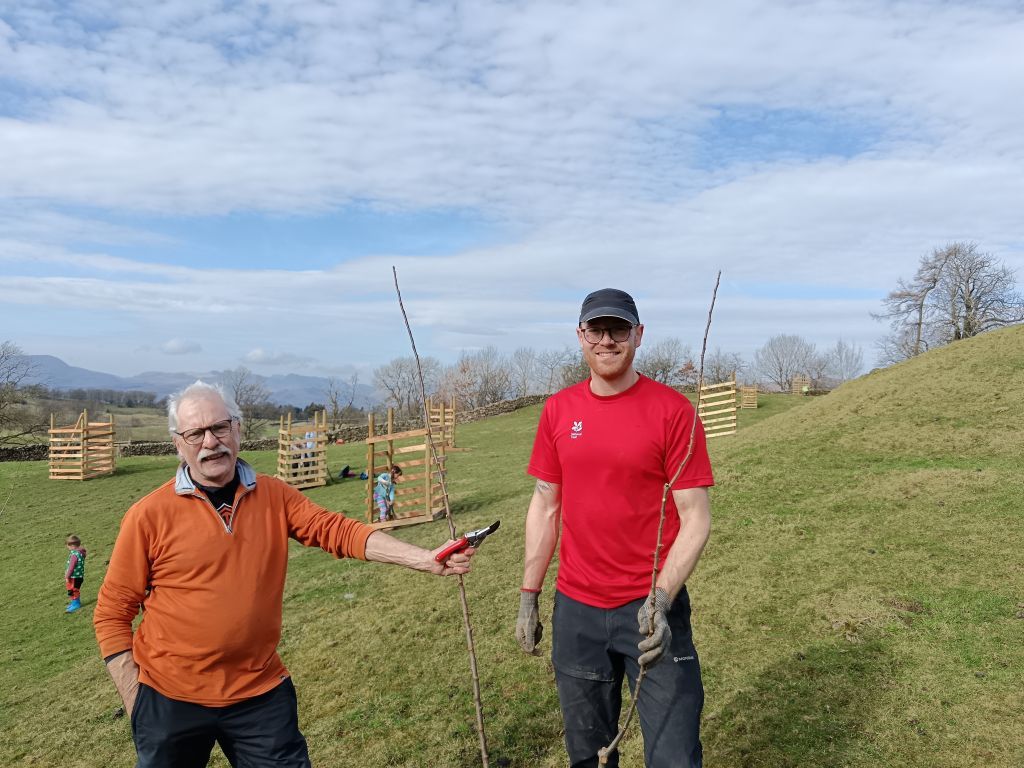
National Trust Rangers, volunteers and members of the local community came together to create a new orchard of rare apple trees in a Lake District town.
The group planted 30 trees in the new orchard at Common Farm in Windermere. Eventually 80 will be planted at the site – and it is no ordinary orchard.
Working with Dick Palmer, of South Lakeland Orchard Group, the National Trust said it aimed to replicate a national collection of rare apple trees from Yorkshire, Lancashire, Cumbria and Scotland.
The trust said it had to build them, grafting scion wood – a young shoot taken from a stem of an existing tree – onto the hardy rootstock of another tree.
After growing to the required height, these small trees were ready to plant in the orchard. The next stage in the process is to finally add the scion wood of the rare apple tree, creating the final rare variety. The full process takes a couple of years.
Dick, who advised the National Trust on the project, said: “At South Lakeland Orchard Group we were pleased to be asked to provide expertise to the project at Common Farm.
“Our aims are to encourage the preservation of existing orchards and the creation of new ones in South Lakeland. Ultimately, rare local tree varieties are part of our common heritage, they define who we are in the same way that vernacular architecture or dialect does
“It’s great to know that the new Common Farm plantings will replicate our national collection of heritage varieties growing in Kendal.”
The work is part of the National Trust’s wider aim to create a thriving landscape, for nature, climate and people in Windermere. The charity has planted 15,000 trees and 9,000 native wildflowers around Windermere in the past year, working with partners, schools and communities.
John Pring, the trust’s countryside manager in Windermere, said: “The trust looks after a patchwork of land throughout the Windermere catchment, this presents us with a great opportunity to protect, restore and create spaces for nature that benefit wildlife and people on a landscape scale.
“Together with our neighbours, farm tenants, the local community and our partners we are beginning to improve, increase and connect pockets of wildlife habitat which can only be good news for nature and will help build climate resilience in the area.”