The Carlisle Citadels project is one of the city’s biggest regeneration schemes in recent history.
It’s a bold £78 million plan to better centralise the University of Cumbria in the city while also linking in with other improvement projects such as the £27 million railway station revamp and the £5.5 million Market Square overhaul.
The Citadels project is being primarily funded by £50 million from the Government’s Borderlands Inclusive Growth Deal and has an overall goal of improving opportunity, footfall and vibrancy in the city.
But it’s also a project that has left some people worried that it is taking away retail space from the city and will only benefit students.
So will benefit the wider city in any way? What will happen to the old empty shops on English Street? What will it look like? And what’s actually in it for the people of Carlisle?
We spoke with the university’s chief transformation officer Tracey Slaven to better understand what the project will really mean for the city.
What is the Citadels project?
The Carlisle Citadels project is a multi-million-pound plan to build a new, improved and centralised University of Cumbria campus in the heart of the city.
It is aiming to improve opportunity, student experience, vibrancy, footfall and what the university offers overall in the city.
Currently, the university is split into two main campuses in the city – Brampton Road and Fusehill Street, which are a 29-minute uphill walk apart.
Once the Citadels project is complete, it will replace the old Brampton Road campus and bring students into the city centre.
The new Citadels scheme and Fusehill Street will then be recognised as one campus across two sites.
Old buildings and former shops on the project site will be transformed into the new university building.
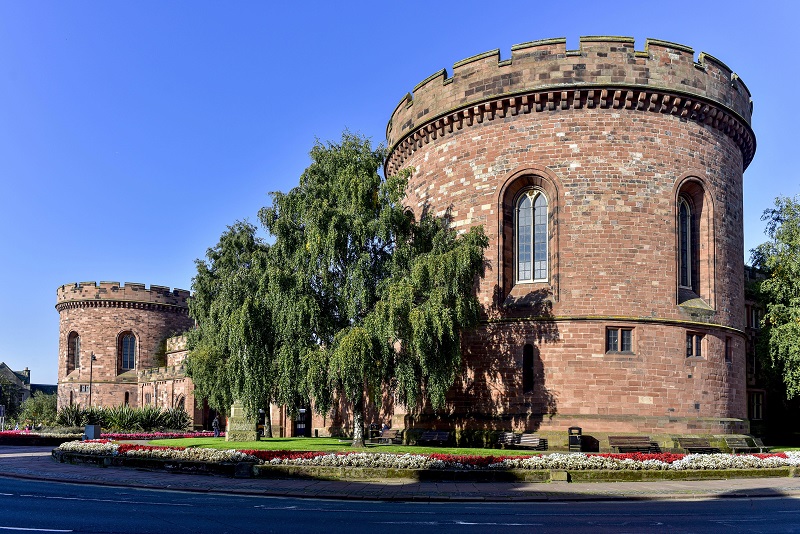
These include empty former shops on English Street, the former Woolworths/Burtons building – latterly occupied by bargain chain B&M – and the former Armed Forces Careers Centre as well as the old hospital wing of the county gaol that sits behind the old crown court at the Citadel.
The two Citadel buildings themselves are currently not being used as part of the project.
The former Armed Forces Careers Centre will also be transformed into the Carlisle Business Exchange – a new venue to give local businesses a space for networking, events and a place to connect with the university.
Public realm work will also go ahead to create a landscaped space with seating on site for students and the public.
The regeneration is also aiming to create a new vibrant gateway to the city that complements other city improvement projects while also opening up the world of higher education to the public.
Tracey said: “It’s a real turning point project for Carlisle, you definitely don’t get many funding opportunities like this.
“It’s a really big investment in the city and there’s a clear recognition from the Government of the importance of Cumbria and the importance of regions being self-driving.
“I think for the city the project is that jigsaw piece in the midst of other developments but also about supporting productivity and the role the university can play in connecting with businesses and with the wider public.”
So, who is funding the project?
The largest chunk of overall funding – £58 million – is being provided by the Ministry of Housing, Communities and Local Government through the Borderlands Inclusive Growth Deal.
The package outlined also includes approval in principle of an additional £8 million through the Borderlands Partnership Board.
A further £5.2 million from the Carlisle Town Deal Fund is also being provided.
Why is the Citadels project happening?
Initial plans for the Citadels project were first announced in 2020 in line with the introduction of the Borderlands Inclusive Growth Deal.
Planning permission was applied for in 2021.
The Borderlands deal is a £452 million Government investment plan to improve infrastructure and opportunities along the England-Scotland border.
It has given Carlisle a chance to access funding for major improvement projects, such as the Carlisle Railway Station Gateway project and the Greenmarket revamp.
Tracey said: “The impetus for a project on the Citadels site started in around 2019 and 2020, which was interesting timing.
“It was all about thinking about the wider redevelopment of Carlisle as the Borderlands deal was just starting up.
“When you think about really redeveloping the city centre, as you start to redevelop the train station and Greenmarket area, you’re left with this gap in the centre of Carlisle and that is the Citadels site.
“At that point it was no longer in use by the council and there was this big question of what should be done with it.”
Tracey said initial ideas looked at by Cumberland Council and partners for the Citadels site included a hotel, residential space and office buildings, alongside possible opportunity for the university.
She added: “A number of options were explored and the one that made the most strategic sense for the city was about bringing the university presence fully into the city centre and creating new reasons for footfall from that.
“It was also about connecting through traffic with a purpose around that bit of the city, as well as connecting the train station and Greenmarket redevelopments.”
Plans to redevelop English Street and both Citadels at the same time were were initially put forward in 2021.
But the project is now focused on the redevelopment of English Street and a public access outdoor social space.
While work will go ahead around them – the future of the two Citadel buildings will be looked at further down the line.
How long will it take to build?
The university is aiming for the project to be finished by the 2027/2028 academic year.
Since plans for the project were first officially lodged in 2021, it has since faced some post-Covid setbacks and building safety challenges.
In 2024, building firm Sir Robert McAlpine pulled out of the project after two years, to concentrate on its other projects.
McAlpine had been working with the university for two years on the Citadels scheme, but after winning tenders for two new large infrastructure projects, it decided to focus on those.
Tracey said: “There was a little bit of a false start, which wasn’t unusual for that post-Covid period, where Sir Robert McAlpine were the preferred contractor.
“For reasons to do with their portfolio and post-Covid management, they decided it wasn’t the right project for them.
“So we had to go back out to tender and we have been going through a process with another preferred tender.
“But last March we had challenges when the tender came in and we couldn’t go into contract.”
Tracey said a period of high inflation, post-Brexit impacts and global disruption hitting the construction sector caused problems, with spikes in steel prices and difficulty attracting construction teams into the region.
She added that there were also concerns with new fire safety regulations around the Woolworths/Burtons building.
She added: “Last March we had a challenge in relation to the delivery of what we were wanting to do with the project at that point.
“So at that point we were looking at development along English Street, the hospital wing around the Woolworths/Burtons corner and a teaching block sitting behind that.
“Those challenges were to do with those external factors and concerns coming in from the new construction company about the potential implications of new fire regulations.
“Because when you’ve got a building that has been as interestingly developed as the Woolworths/Burtons one, then you’ve got all sorts of safety concerns as part of that.
“It has become clear in the period since March that there isn’t a way to make that Woolworths/Burtons building compliant with fire regulations in a refurbishment context.
“This is because is has steel columns supporting the building and wooden ceilings and floors.
“While you can encapsulate both and make them fire safe, as soon as you hang anything from the ceiling like a light, you break that encapsulation and it wouldn’t meet fire safety regulations and the contractor can’t get insurance.”
Tracey said that alternative methods of construction were looked into and that the plan is now to maintain the façade of the Woolworths/Burtons building and build a new space behind it.
The building’s current internal layout will be replaced with a new concrete frame.
Tracey added: “Doing the concrete shell allows us to create a much more inclusive and accessible space.
“Before we had this idea, in order to come down to budget, we were going to have to lose the teaching block at the back of the site and we were really worried about the loss of space potentially impacting on student numbers.
“But moving to this new concrete framing strategy, it’s a much more efficient use of space and we can get all those teaching spaces back into the building.
“So we’ll have a smaller building, but with the same amount of teaching space that we wanted originally.
“But that corner point of the Woolworths/Burtons building has such a cultural resonance and it’s important to us to keep it.”
The university is now working with a preferred contractor and is aiming to go to main contract award in May.
It is also hoping to start some pre-contract work on site this year.
Tracey said: “We are hoping to do some pre-contract work on site in next few weeks, so that would be about the demolition of the old Kramer building that sits behind the site as it stands at the moment.
“That programme would run somewhere between 10 and 13 weeks, so we hope by the time we get to the main contractor point that we have got a nice smooth run into that.
“But we should be able to do a stand up within six weeks of main contract award.”
In the meantime, Tracey said work has taken place to remove asbestos, carry out archaeological and drainage surveys and internal building work like the removal of ceilings as well as monitoring of the Citadel buildings themselves.
She added: “We are really pushing hard in terms of the timeline because the work is going to take a couple of years on site. We want to be ready and completed within the 2027/2028 academic year, so it is tight.
“But that will allow us to do a nice smooth transition in terms of bringing the arts programmes down from Brampton Road and some of the education and business programmes from Fusehill Street and get that all on site so we can get them up and running.”
What will happen to the Brampton Road campus?
The project, once complete, will replace the current Brampton Road campus.
All programmes being run on the old campus – which is mainly home to arts students – will move into the new site once it is complete.
Tracey said: “We need to be exiting Brampton Road. Maintaining three sites would just be extremely difficult and as the use of Brampton Road has evolved over the years, we’ve not been using the spaces in the way they were originally intended.
“It’s lovely, but I think sometimes student experience can be impacted up there because it’s a bit excluded, so part of bringing them down is about improving student experience.
“There will be a process of moving out of Brampton Road and we will look at it in terms of what it’s future use might be in terms of how we dispose of it.
“But that needs conversations with the council and to be carefully thought through.”
Science and nursing programmes will remain in Fusehill Street along with professional services staff.
Pears Cumbria School of Medicine will also remain in Fusehill Street.
What kind of facilities will the new scheme have?
Once complete, the new scheme will have several different facilities for students.
As the project is replacing Brampton Road, primarily an arts campus, many of the facilities will be arts focused and will be spread across three floors.
They will include:
- Photography studio
- Digital animation and high performance lab
- Graphic design illustration space
- General teaching space for business programmes
- A moot room for law students to practice
- A ceramics studio with an electric kiln
- Print workshops
- Early years teaching space
- A fine art studio
- General teaching space
- A landscaped forum
- Exhibition space
- The Cumbria Business Exchange – which will offer seminar, lecture, meeting rooms and event space
- A quiet study corridor space, chaplaincy room and student support
- Two lecture theatres that connect to the business exchange
- A small arts library
- Soft sitting and waiting areas
- A TV studio
- Plant rooms
- Support services
- A students union office
- Staff spaces on each floor
- One to one meeting spaces
Tracey added that food wise, only a small reheat kitchen and coffee stand will be in the new building to encourage students to venture out into the city.
She said: “We want to make sure in our design that we’re not pulling business away from local cafes and restaurants.
“So we haven’t included a big café. Our intent is for students and staff to do out and buy things and use the social space on the ground floor that will be porous access.
“We wanted to just do a reheat kitchen on site so if we have a catered event, we can draw in a provider from the city to do that.”
So what will happen to the empty shops on English Street?
All of the empty shops on English Street will be redeveloped for the Citadels project.
While the the Woolworths/Burtons building cannot be developed to meet new fire safety regulations, its façade will remain.
The university said it is keeping the façade to honour the building’s cultural standing in the city.
A new concrete frame will replace the building’s current internal layout, allowing for better accessibility and teaching space.
What will happen to the two Citadel buildings?
The future of the two circular Citadel buildings has not yet been decided.
But some form of development or improvement of the buildings will have to take place in the future as part of the university’s grant agreements for the overall Citadels project.
Work on the two Citadel buildings will not take place at the same time as work on the rest of the site.
Tracey said: “There really needs to be a lot more work done to look at the Citadels and what the best use for them would be.
“They’re complex buildings and they’re not in particularly great condition and they are not really very well suited for the purposes of modern teaching, so it wouldn’t be right to compromise them.
“They are listed buildings and we really need to be thinking about how they are used.
“But one of the things that will be a grant condition for us with the council is to go back into the Citadels, see what the condition of them is, and then start to think about what the right future is for them.
“It might not be an education future for them, but it could be something around the arts. That future isn’t yet in play, but all of the strategic partners in the city need to be thinking about where they go next.”
How will the Citadels project benefit students?
The citadel project is aiming to improve student experience by centralising the university in the city.
Students who have classes in Brampton Road are currently a 29-minute walk outside of the city, which Tracey said the university is keen to change.
Tracey said: “It will really allow people to see and feel what a university experience in Cumbria might be like for them in a way in which is not very visible at the moment, as we are quite tucked away.
“It’s about giving people the chance to look through the glass walking along English Street and being able to see someone and think, that person looks like me, if they can do it, why can’t I do it.”
The university is also hoping the Citadels project will attract more prospective students by offering up improved modern facilities.
Once complete, the Citadels site will mainly be home to arts, law, early teaching and business students.
Tracey said that the university wants the project to give its arts provision a revamp.
She added: “Putting arts in the Citadels and bringing it back to the city centre is important. Our arts feels like it needs a little bit of a renaissance in terms of education provision.
“There’s a very strong arts and culture scene but it’s a little bit disconnected and we want to improve that. We also want to build our connection with Carlisle College who have some fab programmes on offer, so working with them.
“We know there’s been a nationwide trend of reducing numbers of young people going into arts programmes, but it can be such an incredible way of adding vibrancy into the city and we want to build on that.”
Will it only benefit students?
While the new building will benefit students, the university is aiming to support the wider area and public in other ways.
Tracey said that by bringing more students into the city centre, the university is hoping to improve footfall for local businesses and vibrancy for residents and workers in the area.
The Citadels project will also offer an improved gateway to the city for people travelling in via train and connect other major improvement projects together, such as the station revamp and Market Square redevelopment.
A landscaped forum space outdoors will also be open to both students and the wider public.
As part of the project, the university is also creating the Carlisle Business Exchange – which may be renamed – as a way to connect with local businesses and improve student opportunities.
Tracey said: “We are siting the Carlisle Business Exchange on that corner in the Burtons/Woolworths space.
“So what was Woolworths entrance will become the entrance to engagement with the university, with our students and entrepreneurship development.
“It will open the doors so the business community can come into our university space in a very visible way, people will be able to see the buzz happening through the windows.
“We’ll have space for seminars, meeting rooms, an open informal discussion space open to small events and a mezzanine floor with little office spaces for small spin outs or advisory functions that has a porous interface to the university space itself.
“In our redesign we’ve also built in two lecture theatres, one of which the business exchange will have access to.”
Tracey said the university wants the exchange to be an interface for businesses and the university, whose business programmes will be sat above the exchange.
She added: “We’re the University of Cumbria, we’re here to support Cumbria, to address participation and to get skill levels higher to support productivity.
“If you’re a graduate in Cumbria, the balance of skills and insight you need might be different to someone doing a business programme or law programme elsewhere.
“You are going to need entrepreneurial skills and insight into how to run your own business.
“You’re much more likely as a young lawyer to end up a partner in a small law firm here than if you were starting a law career in the middle of Manchester and we want the business exchange to help bridge that knowledge gap.”