
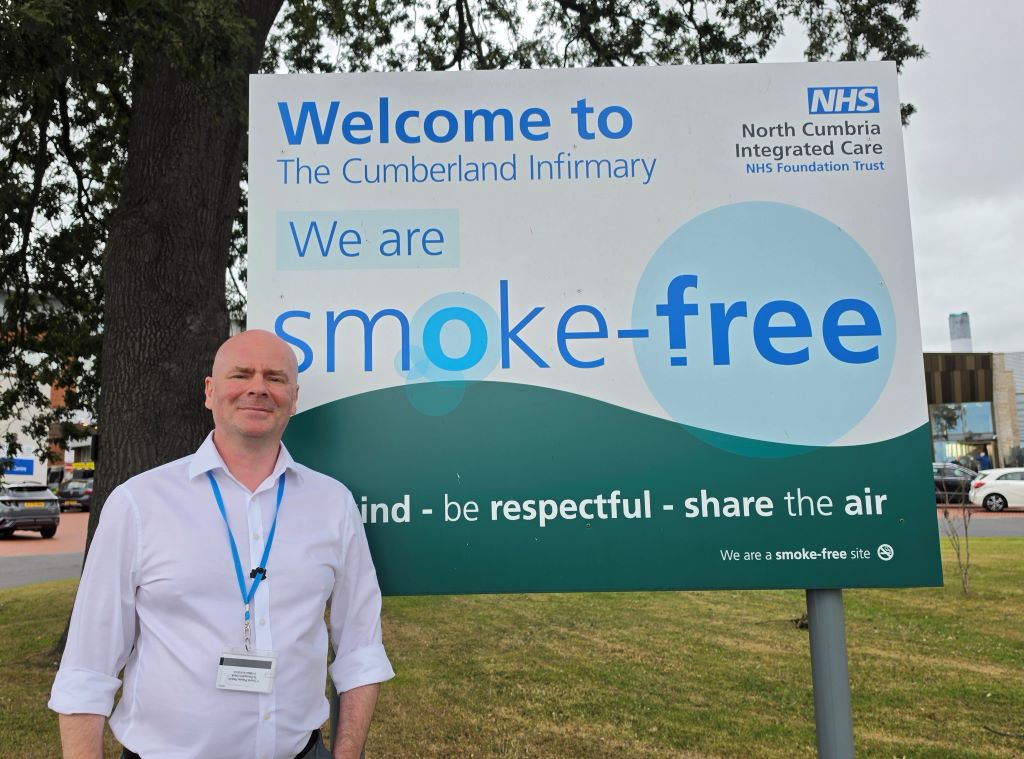
A campaign has been launched to help keep north and West Cumbria’s hospitals smoke-free.
The campaign aims to remind people that smoking is banned across all hospital sites run by the North Cumbria Integrated Care NHS Foundation Trust.
The trust runs Carlisle’s Cumberland Infirmary, the West Cumberland Hospital in Whitehaven and community hospitals.
It said the project was designed to protect people from the harmful effects of second-hand smoke.
The trust said smoking remained the leading cause of preventable illness and early death, and that even small amounts of smoke in the environment could affect people who were already unwell.
It added that many people who went to hospital were vulnerable, including those with breathing problems, heart conditions, cancer or weakened immune systems, and keeping the air clean could make a difference to their recovery and comfort.
Jason Cram, deputy chief nurse at NCIC, said: “Our patients, visitors, neighbours and staff should be able to access an environment that enables that promotes clean air or the waste produced from cigarettes.
“Keeping our hospital sites and neighbouring community smoke free is one of the simplest ways we can all help protect them.
“We know that stopping smoking, or going without even for a short time, can be difficult. That is why we offer support to help people manage cravings and, if they choose, stop smoking for good.
“I would like to thank the many patients, visitors and colleagues who already respect our smoke free sites and help us create a healthier environment for everyone.
“We all share the air. Please help us keep it clean. Let’s keep NCIC smoke free.”
Rachel Fulton, matron for maternity services, added: “Many women come to hospital regularly during pregnancy for appointments and scans.
“No one should have to walk through cigarette smoke to access their care.
“Our smoke free sites help protect pregnant women, babies and families.”
Patients admitted to hospital can receive help from a tobacco dependency team to stay smoke-free during their stay, which includes access to nicotine replacement to manage cravings. Support is also available after patients leave the hospital.
FAQs
The trust has answered some frequently asked questions about smoking at its sites.
Why isn’t the trust enforcing the no‑smoking policy by asking security guards to intervene?
It said: “The trust’s no‑smoking policy applies across all our sites, and smoking is strictly prohibited.
“We expect patients and visitors to respect our policy and the signs that are in place.
“Enforcing this policy in open public areas is challenging.
“While security teams play an important role in maintaining safety, their role does not include approaching individuals about smoking.
“Direct enforcement can place staff in difficult or confrontational situations that fall outside their remit.”
Why doesn’t the trust install a smoking shelter on site to discourage smoking at the main entrance or near neighbouring homes?
The trust said: “The NHS and the trust is a smoke free organisation.
“Therefore, we cannot provide a shelter. Installing a smoking shelter would contradict the trust’s smoke‑free policy and create a space that effectively legitimises smoking on our grounds.”
How are you discouraging smoking in neighbouring areas if people are asked to move off site?
It said: “Our approach focuses on reducing smoking overall, not relocating it.
“We are actively tackling smoking by providing support for staff and inpatients, and by directing visitors to stop‑smoking services that can help them quit for good.
“The more people we help to stop smoking, the fewer issues there are both on Trust grounds and in surrounding neighbourhoods.
“We recognise the concerns raised by our neighbours, and we remind colleagues who do smoke to be respectful when off site and to avoid smoking near residential boundaries or busy footpaths.
“While smoking is banned on trust property, enforcement in open public areas can be challenging, and we rely on individuals to act considerately and responsibly.
“Our priority remains creating a smoke‑free environment that protects patients, visitors, staff and the wider community, supported by clear signage, public messaging and access to effective quit‑support.”