
The building and flight of a replica of the UK’s first successful seaplane is receiving accolades and national awards from the world of aviation.
The team behind the Waterbird project have pledged to return to Windermere for more flights and hope to create a heritage centre to mark the key part the lake played in the history of seaplanes.
After 12 years of development, Waterbird’s replica finally took off from the lake in private trials in June 2022.
Then, on Friday, September 23, it made several short flights in front of an enthralled crowd of hundreds of spectators on Rawlinson Nab, who burst into applause when it rose from the water.
Public flights were also due to have happened the previous day but had to be called off due to heavy rain.
But on the Friday, the sun broke through the mist and the gentle breath of wind came down the 10-mile-long lake from the south, into which the plane was able to take off.
It achieved four flights of about half a mile each, reaching about 50mph and rose 50 feet above the water.
Pilot Pete Kynsey said: “Everyone one of the flights was a delight to do. The conditions were perfect. It was like a relaxed day out.”
The flights were the culmination of 12 years dedication by the team, which is now being recognised with awards.
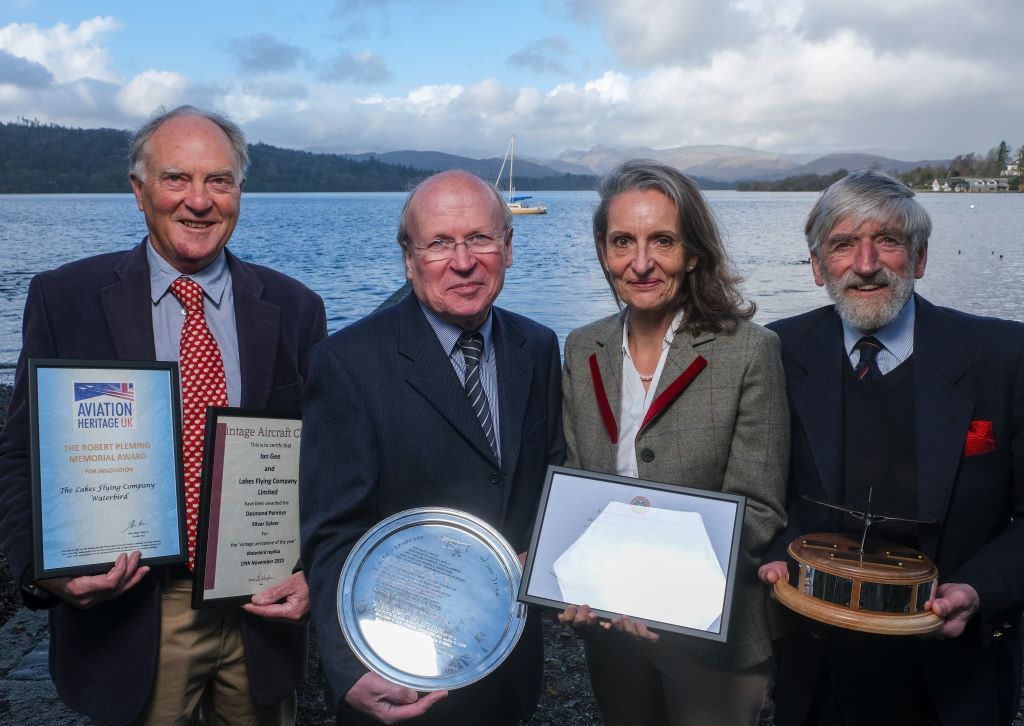
So far, the Lakes Flying Company, the charity behind the project, has won: The Bremont Special Recognition Award from the National Transport Trust; The Robert Pleming Memorial Award for Innovation from Aviation Heritage UK, which commemorates the inspirational chief executive of the Vulcan to the Sky charity, who died in January 2021; and The Desmond Penrose Silver Salver for vintage aeroplane of the year from the Vintage Aircraft Club, which commemorates a Royal Aircraft Establishment test pilot.
Ian Gee, a retired solicitor who lives near Kendal, is chairman of the Lakes Flying Company.
He said: “The build of the replica Waterbird commenced in 2010 and was flown both as a landplane and then a seaplane.
“We commissioned five large technical reports. So, ultimately a stage was reached where we had official approvals backed by computer predictions that all would go well.
“Nevertheless, nothing had prepared me for the trials at Windermere in June when success was achieved at the first take-off run.
“The awards reflect the tremendous work carried out by the Waterbird team to reach the goal of public flights at Windermere.
“We are already planning to return next year, this time in the northern part of the lake, subject to permission from the Lake District National Park Authority
“To put the replica of the 1911 original into perspective for the era represented. In terms of seaplanes which are now airworthy in the world, there are a 1935 original in Italy and a 1929 original in America, otherwise prior to 1936 there is no other original, restoration or replica.
“The replica is back at Liverpool Airport, but we very much want to establish a centre at Windermere to acclaim the vitally important local seaplane heritage of not only 1911-1919, but also 1943-1945.”
This last is a reference to the Windermere factory where 35 Sunderland seaplanes were built during the second world war.
The site, now the home of the White Cross Bay leisure park, consisted of two huge buildings, one serving as a factory and the other as an assembly hangar.
Apart from a modern engine, Waterbird faithfully recreates the detail of the original seaplane from 1911.
The replica has been constructed from wood, bamboo and wires: the same materials used to construct the original seaplane.
The 35ft long aircraft, has a wingspan of 40ft and weighs just 1000lb. It is powered by a Rotec 2800 radial engine, substituting for the original 50hp Gnome Rotary.
One of the challenges for the team behind the project had been to remain faithful to the original construction, while meeting modern health and safety rules.
Waterbird was the first seaplane to successfully fly in the UK. She was commissioned by Captain Edward Wakefield from AV Roe & Co (‘Avro’), of Ancoats, Manchester, as a landplane and converted to a seaplane at Windermere, where the pilot was Herbert Stanley Adams. Her original historic flight was on November 25, 1911.
Captain Wakefield was a landowner in the Lake District and developed Waterbird to take off and land on water which was seen as being less dangerous to pilots in pre-war flights.
His great nephew Sir Humphry Wakefield, of Chillingham Castle, Northumberland, was among the crowd who saw the public flight.
He said: “My great uncle, a veteran of the Boer War was snubbed by Government scientists when he suggested people’s lives would be saved by taking off from water.
“Within two years he developed, built and patented a unique float which made it possible and is still of the type still used on seaplanes manufactured today.
“I am thrilled to have his memorial made real in Waterbird.”
Retired Rear Admiral Tom Cunningham of Navy Wings, a charity which commemorates British Naval Aviation History, said: “To deliver a project like this is a huge achievement, with technological challenges not faced for more than 100 years.”
Another attendee was Sir Ben Bathurst, former First Sea Lord, and President of the Lakes Flying Company, who said: “This has been a wonderful project to replicate this beautiful aircraft and demonstrate the fragility of early aviation.
“I congratulate the persistence and skill of all those involved.”
The Lakes Flying Company Ltd, a registered charity, hopes to find a permanent home at Windermere for Waterbird, to serve as a heritage centre and from where it could give future demonstration flights.
A documentary on the Waterbird project is due to be shown at 9pm on Thursday, December 1, on the More4 channel. See: https://we.tl/t-w5pKU9gtZj