A pioneering West Cumbrian drone team will be at the forefront of future technology designed to change the way hazardous environments are monitored across the UK.
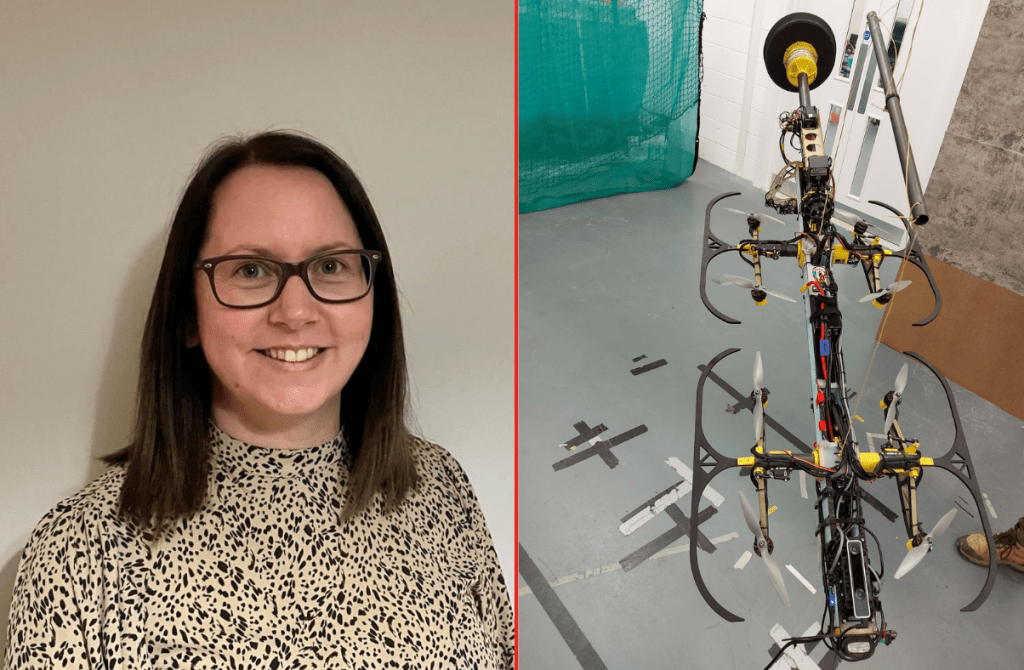
Amanda Smith, Sellafield’s unmanned aerial vehicle equipment programme lead, and equipment engineer Adrian Johnson, were asked as end users – people who regularly use drones – to take part in a national competition for remote monitoring of sensitive sites.
Amanda and Adrian, who are based at Sellafield’s Engineering Centre of Excellence at Cleator Moor, are now helping shape the next phase of unmanned aerial vehicle technology by giving an end user perspective on what will benefit decommissioning sites across the UK.
The expert drone duo were also asked to give their input at a recent demonstration event for one of the projects funded by the Nuclear Decommissioning Authority competition at Milton Keynes due to their innovative use of UAVs at Sellafield and throughout the NDA estate.
The demonstration displayed cutting edge UAV technology which involved designing capability from scratch to enable drones to land on surfaces of any orientation and then use an arm to deploy tools to carry out tasks.
Amanda said: “This technology will revolutionise the use of drones in hazardous environments as it will transform them from being a monitoring tool to being used to actually do the job as well.
“These drones have multiple arms – and can be fitted with whatever tools you want to complete a task – it’s a bit like a Swiss Army knife approach.
“It’s a very impressive and exciting development for the use of UAVs. It’s technology we could be seeing used at Sellafield and throughout the NDA estate within the next two years.
“We are pleased to be recognised for our work at Sellafield and across the NDA estate to the extent that our end user advice is valued on projects and technology such as this, which is important for the future monitoring of sensitive sites across the UK.”
She added that the team’s next steps will be to work with the company involved to share their expertise on potential use cases on site and across the NDA estate.
She said: “It’s a smart way of working because it means that businesses who are developing solutions which will be important for a range of industries avoid spending all their time, effort, and money on developing technology only for the end user to say: ‘it would have been so much better if you only you had done this’.
“It gets that thinking and expertise from the end user into the process at the outset which is a much more time-efficient and cost-efficient way of working and of developing new technologies.
“It’s also fascinating speaking to the owners of these small tech companies, who are at the cutting edge of developing these products and discussing what technologies they are developing and seeing what possible uses they might have.
“It gives us an insight into what is up and coming and makes sure that at Sellafield and the whole of the NDA estate we are at the forefront of these developments.
“There are so many situations you might not immediately think about where this technology can be most effective. We heard how this technology had been used in a range of defence and security applications, including the clean-up in the aftermath of the Salisbury poisonings.”
NDA innovation delivery manager Andrew Gray said the organisation was excited to be working with DASA to provide over £700,000 in funding to develop the innovations to help monitor sensitive sites without the presence of humans.
He added: “These technologies will help us deliver our mission in different ways, enabling us to move our people away from harm and undertake work which will ultimately accelerate the safe and secure decommissioning of our sites.
“Involving the end user is crucial in all aspects of our competitions, to help frame and drive the technologies into forming the best possible solutions, and we are very grateful to the Sellafield team for their support.”