Controversial plans for 164 new homes in a West Cumbrian town are set to be given the go-ahead.
Gleeson Homes wants to build the new estate on two former agricultural fields opposite Uldale View in Egremont.
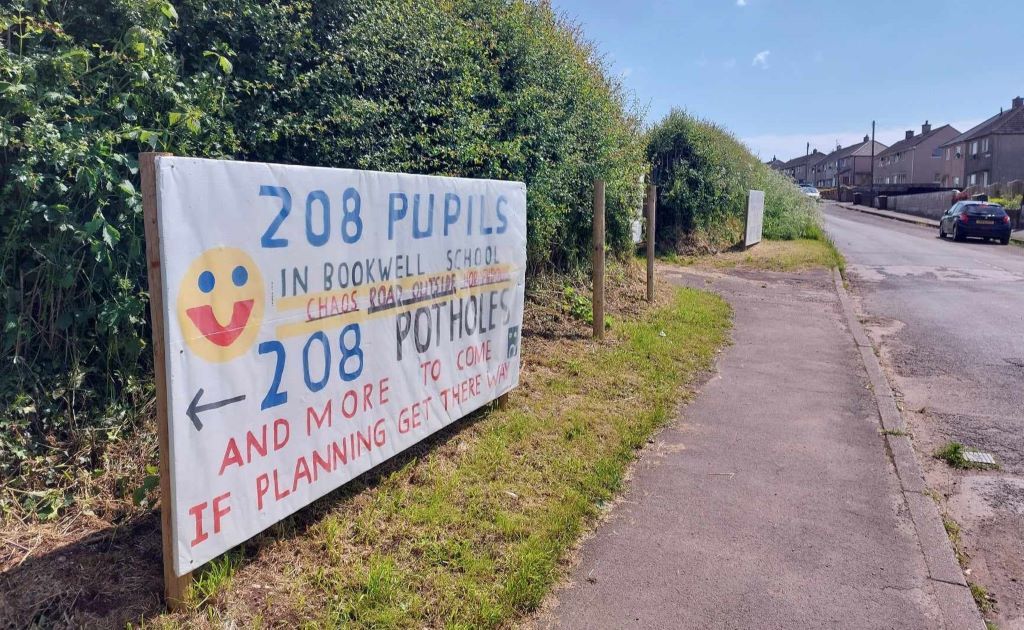
The scheme has sparked outrage in the town, with protest banners appearing near the site, highlighting concerns over an increase in traffic near local schools, potholes and the homes being built on agricultural land.
Members of Cumberland Council’s planning committee are due to discuss the planning application tomorrow, Wednesday July 17, and have been recommended to authorise delegated authority to the assistant director of thriving place and investment to approve planning permission, subject to conditions.
The developer would have to:
- deliver a required 10% affordable homes (16 in total)
- provide a travel plan monitoring fee of £6,600
- provide £41,700 for footway improvements between Uldale View junction and Bookwell School
- provide £1,065,480 to provide additional accommodation capacity at Westlakes Academy
- provide £83,000 towards the offsite upgrades to local plan, sport and open space provision
The housing estate would consist of 13 two-bed homes, 90 three-bed homes, 57 four-bed homes and four five-bed homes.
Ninety-one people objected to the development and when a reconsultation was issued after the plans were altered, 15 people raised objections.
Egremont Town Council said that in general the application was welcomed and would make a positive contribution to the town.
However, it added: “The overwhelming concern is about the additional traffic that will be generated by this development and its impact on the immediate local area
specifically the access to Bookwell School due to its proximity to the development.
“The volume of traffic, especially at peak start and end of school days, is already of serious concern, especially since the removal of the school crossing patrol.”
However, the highways authority said it had no objections and added: “It is noted and accepted that there are no recorded injury incidents in the immediate area over the past five years.
“There is no reason to conclude that the proposed development would lead to an unacceptable road safety risk as long as the necessary provisions to facilitate and manage vehicle, pedestrian and cycle access and movement to and from the development.”
United Utilities said: “We would like to take this opportunity to highlight to the local planning authority and the applicant that the development is in proximity to
Egremont Wastewater Treatment Works.
“It is important to explain that the wastewater treatment processes may result in emissions including odour and noise. It is important to also add that the facility requires continued access. The access may be used by tankers and other large vehicles, so necessary provision to our facility must be left by the applicant for the lifetime of this development.”
But Environmental Health said: “Looking at the plans of the development, the nearest proposed dwellings look to be approximately 300 metres to the west/north west and at approximately 20 metres higher in elevation in relation to a United Utilities site in the valley below.
“The proposed dwellings are not directly ‘upwind’ from the United Utilities site as the prevailing wind direction comes from the south west. There are no past complaints of noise or odour from Egremont site.”
The council’s historic environments officer said: ” The applicant has helpfully commissioned an archaeological desk-based assessment.
“The results indicate that the site lies in an area of some archaeological potential. It is located in a former medieval deer park and cropmarks indicative of a prehistoric enclosure exist in an adjacent field.
“It is therefore considered that there is the potential for buried archaeological assets to survive on the site and that they will be disturbed by the construction of the proposed development.
“Consequently, I recommend that, in the event planning consent is granted, the site is subject to archaeological investigation and recording in advance of development.
“I advise that this work should be commissioned and undertaken at the expense of the developer and can be secured through the inclusion of a condition in any planning consent.”