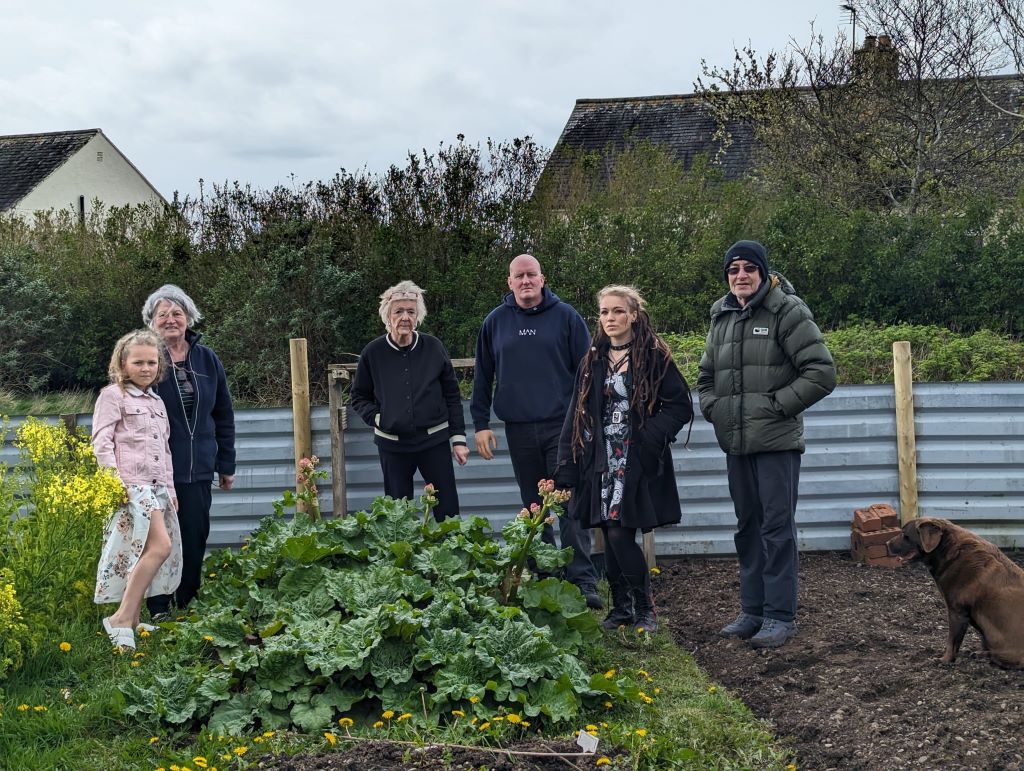
Controversial plans for five new bungalows on a West Cumbrian housing estate – which prompted police being called – can now go ahead.
Residents of Westfield say a piece of land behind Garth Road, used by people for allotments, is subject to a covenant, but Westfield Housing Association want to build bungalows on the site. The association said there were no such restrictions on the site.
In April, tenants said they were left reeling when agents of Westfield Housing Association were sent in to stop what it termed unlawful activity.
Police were also called in and the housing association said it was currently consulting its lawyers regarding further legal action in relation to the behaviour of tenants and ‘also some of the subsequent potentially defamatory reporting of it’.
But residents said they have been tending allotments there for years.
However, the association said it wanted to build five bungalows on the land for older people and the land was wholly owned by Westfield.
In December 2023, its application for the new homes was refused by Cumberland Council, which said the space contributed to the amenity of the area by virtue of its open character and the proposals would have a significant impact. It added: “The economic and social benefits of the proposal do not outweigh the value of the undeveloped site.”
The association lodged an appeal with the Planning Inspectorate, which has now said the development can go ahead.
The inspector’s report said: “A small part was formerly used as a private allotment by one of the neighbouring properties. The site is largely overgrown with unmanaged grassland, encroaching brambles and scrub.
“The neighbour representations indicate that the appeal site was historically used as allotment land. However, while a part of the land was leased on a
private basis to a neighbour and used to grow produce until relatively recently, there is little evidence in relation to any wider use of the site.
“Moreover, irrespective of the demand for allotments in the area, the appeal site is privately owned and not protected under the relevant allotment legislation.
“I understand that the undeveloped green space is valued by the surrounding residential occupiers. However, it makes little visual contribution to the character and appearance of the townscape and it is not in community use. It seems reasonably unlikely that the appeal site has any discernible value to the wider community and it is not an asset of community value.”
Westfield Housing Association previously told Cumbria Crack there was a private allotment tenancy on the site since April 1 2013, and the tenant of this allotment received notice to vacate the allotment in October 2021.
A spokesman added: “Thereafter, Westfield allowed the tenant to keep the allotment temporarily and rent free as a gesture of goodwill until this temporary free use was recently brought to an end by Westfield upon further notice to her.”
But Councillor Sean Melton, who sits on Workington Town Council, said: “The allotments were well established. These people weren’t just growing food for themselves, they passed on food to other people in the community. Children went there to learn about gardening and the allotments were well cared for. Youngsters won’t be able to grow anything now.
“There’s a cost of living crisis happening and the housing association felt this was the best way of going about things. I am disgusted and the residents of Westfield are disgusted. People’s mental health will suffer as a result of this.
“I understand other housing associations are turning community land into allotments and growing areas because of the cost of living crisis and to help with people’s mental health. I don’t understand Westfield Housing Association’s rationale behind this – except the fact that it wants to build some bungalows.”
However, the planning inspector said: “Workington has an increasingly aging population and a higher than average percentage of households in fuel poverty and on Universal Credit.
“As a result, there is an identified need and a significant unmet demand for accessible and adaptable dwellings, including older persons housing, and also for social or affordable rent housing.”