Cumberland Council has been told it acted unreasonably when it rejected plans by a West Cumbrian factory to erect a wind turbine.
It had been recommended for approval. The firm appealed the decision and the Planning Inspectorate has now overturned its ruling, so the turbine can be built.
The planning inspector has also ordered Cumberland Council to pay New Balance’s costs.
Her report said: “It relies to a substantial extent on the fact that the planning committee failed to accept the views of its professional officers to grant permission, and the view that the council subsequently failed to substantiate the reasons for refusal by objective analysis at appeal.
“Planning committee members are not bound to accept the recommendations of their officers. Nevertheless, reasons for refusal should be substantiated and based on relevant evidence.
“The council refused the proposal with a single reason for refusal that covered a number of aspects. The council therefore acted unreasonably in relation to all but one aspect of the reason for refusal. It was unreasonable for the council to refuse planning permission.”
New Balance will now apply for the council to pay its costs for the appeal, which have yet to be determined.
The new turbine would cover the energy needs of the factory and any surplus energy created would be sold to its second factory.
Seaton Parish Council objected to the plans and residents were concerned about noise, flooding, flicker and its ‘topple distance’ – the area where it would fall if it toppled over. There were also concerns about its impact on the landscape and environment.
The inspector said: “The proposal received 21 letters of objection and 20 letters of support during the application and a further limited number of objections during the appeal.
“Public views on the scheme are therefore finely balanced and not indicative of a lack of community support.”
In a five kilometre area around the factory, there are 28 existing wind turbines – 10 of which are within a kilometre of New Balance.
The inspector covered each of the areas of concern in detail in her report:
Visual impact
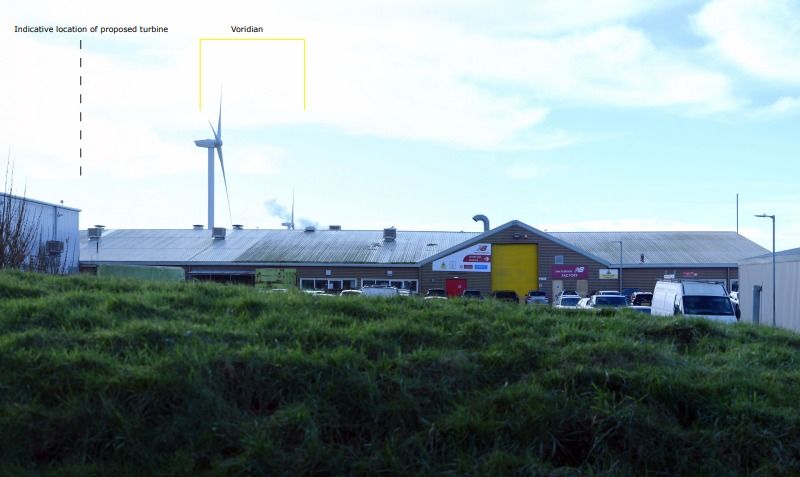
The turbine would be visible when travelling along the A596 between Workington and Maryport and from some more limited points on the local road and footpath network, particularly in elevated locations such as Flimby Brow.
In these views the effects would have only a very limited harmful visual impact as the structure would be viewed in the context of the other turbines and built
form along the coastal edge.
I am therefore of the view that the proposal would not have a significant adverse impact upon the landscape character or the character of the area.
Noise
A noise impact assessment found that the predicted noise levels from the proposed wind turbine would be significantly below the daytime and night-time background noise levels and adopted limits across each wind speed. Furthermore, the cumulative noise assessment found that during both the daytime and night-time, noise levels from the proposed wind turbine would have no impact on existing consented wind farm noise levels.
Subject to an appropriately worded condition setting upper noise limits, I am satisfied that the scheme would not lead to noise that would have a harmful effect on existing living conditions.
Flicker
he company’s assessment showed that eight homes were predicted to experience more than 30 hours a year of shadow flicker if the turbine went ahead and put forward a shutdown scheme to eliminate that.
The turbine’s blades would stop rotating for defined period specified within the shutdown scheme.
The inspector said:
Studies identify that some of the windows for nearby properties would have the potential to be impacted by shadow flicker on clear days, predominantly between October and February.
Impacts are avoided if the times when shadow flicker is likely to occur are identified and the turbines shutdown at those times when there are clear skies. Although there is no adopted policy in England as to what a reasonable level of impact might be acceptable, guidance in Europe and elsewhere recommends no more than 30 minutes a day and 30 hours a year.
This established guidance has been found to limit shadow flicker to levels that are generally accepted as limiting intrusion and so I have taken them into account.
The appellants state that the report identifies the cumulative impact of shadow flicker but I am not convinced that this is the case. I have not been provided with any explicit analysis of flicker caused by any other turbine and residents have identified flicker as being an existing problem
Submitted assessments show that even if the turbine was shut down for every instance of shadow flicker predicted to arise from this proposal, such shutdowns would only apply for a very limited period across the year and dependent on weather may not always be necessary.
I am therefore satisfied that an operational model which shuts down the turbine when shadow flicker is likely to occur would be feasible and workable if in the light of cumulative impacts this is found to be required.
Topple zone
The topple distance for the turbine of tip height plus 20% includes part of the New Balance Factory. Development is not precluded within the “topple zone” and I note that there are instances of development close to turbines within the surrounding area.
The appellant has submitted a risk assessment which includes measures to ensure the safe construction and operation of the turbine which I consider provides assurances that the installation will be carried out and maintained to high standards.
It would be maintained and monitored by a professional company who specialise in wind turbine safety and it would be operated by New Balance as part of their business from the site. Wind turbine failures are also extremely rare with no instances of such in the area.
Flooding
I note the concerns of residents in relation to drainage and potential surface water flooding. The scheme would be supported by a surface water drainage strategy secured by condition which would ensure the scheme did not have an adverse effect on drainage and so I am satisfied that the scheme would not give rise to harm in this regard.
Highway safety
Residents have also expressed concern that the scheme would have adverse effects on highway safety, particularly during construction. Subject to an appropriate condition to secure a construction traffic management plan, I am also satisfied that the scheme would be prejudicial to highway safety.
Conditions
The inspector imposed a number of conditions for the turbine.
She has limited its operation to 25 years and it will have to be removed entirely if it is non-operational for more than 12 months.
Other conditions are:
- A plan for decommissioning
- A construction traffic management plan
- Approval of a surface water drainage scheme
- Grassland management plan
- Work should not take place during the bird breeding season