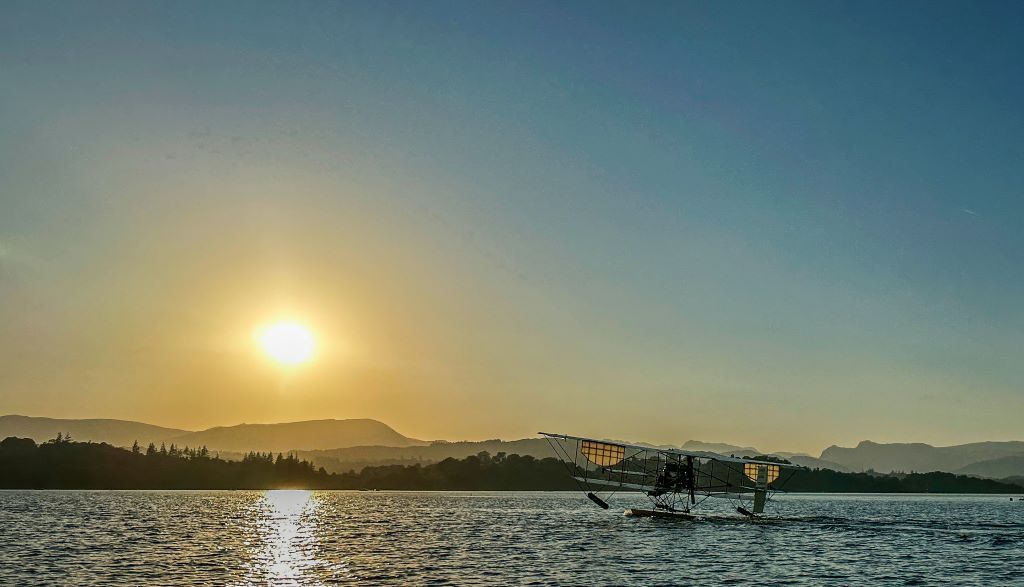
The sun has set on the stunning annual public flights of the replica of the UK’s first seaplane, writes Mike Glover.
Waterbird is now back in its hangar in Liverpool, after two evenings of spectacular flights on Windermere seen by hundreds of spectators.
“They came from all over the UK – there were even three gentlemen from Brazil – especially to see the displays, so it must have been very good for the hospitality businesses,” said Anne Hughes, trustee of the Lakes Flying Company Ltd which is behind the Waterbird project.
As well as Waterbird, spectators at Brockhole, saw a flyby of a Lancaster bomber and an Aviat Husky modern seaplane on Friday.
Waterbird also had three short flights on Saturday.
“Both evenings were a success, with the sun setting at the end of the displays. It was stunning, ” said Ms Hughes.
“There was a steady stream of visitors to the information gazebo and it was great to see youngsters in the water waving to the pilot and him waving back. We will be back next year,” she said.
The pilot this year was Lieutenant Commander Chris Gotke, a serving Royal Navy pilot who holds the Air Force Cross.
Ms Hughes was keen to emphasise that the Lakes Flying Club is a charity and depends on donations to keep the flights going. There is no public funding involved.
Both the Lancasters and Waterbird were built by Manchester engineering company, Avro, which was absorbed into Hawker Siddeley in 1963, which in turn became British Aerospace in 1977, and finally BAE Systems in 1999.
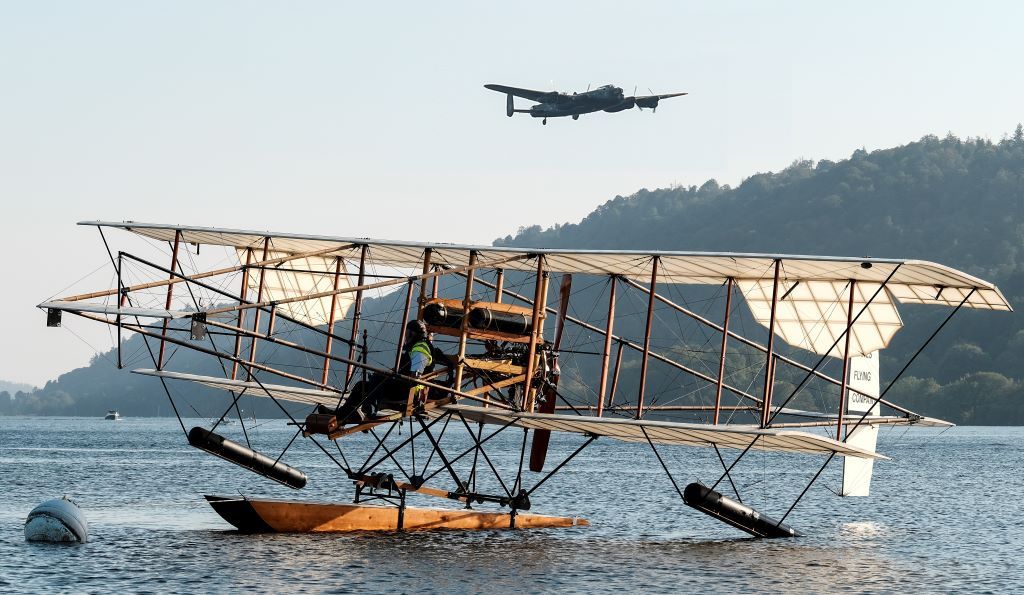
The Lancaster performed its fly-past on its way to an airshow in Ayr, Scotland.
It was the third year of flights by the replica Waterbird, which was built by Lakes Flying Company Ltd after 10 years of research and development to its original specifications, except for a modern engine.
It is now looking for a permanent home by Windermere, where the original plane was built and tested in 1911, under the auspices of Captain Edward Wakefield.
The Waterbird Project has also opened the first permanent exhibition recording the vital role played by Windermere in the history of the development of aeroplanes at Windermere Library.
With thanks to Milton Haworth for the photographs.