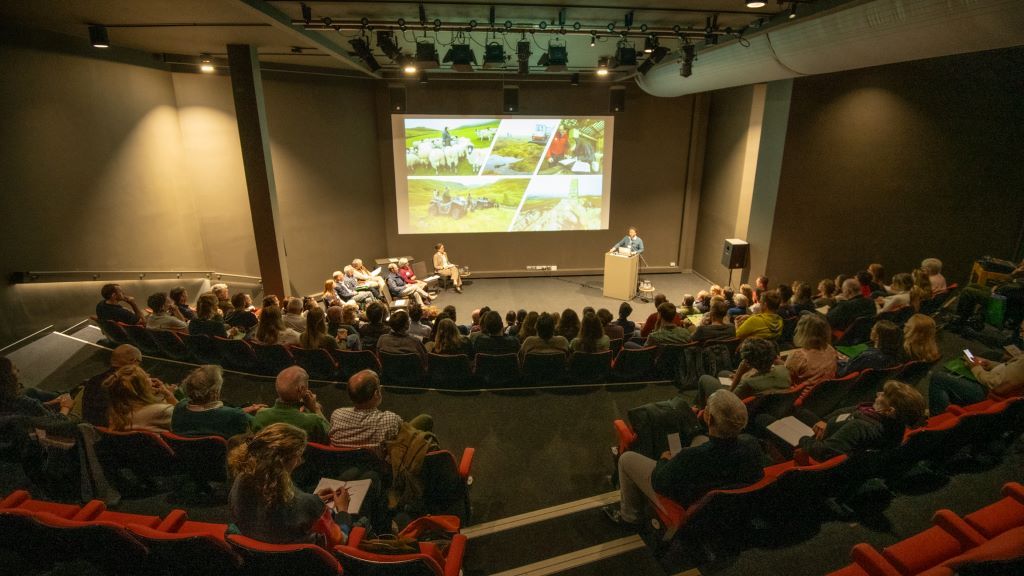
Over 100 people gathered to share their knowledge of working on the Heritage Lottery funded Our Upland Commons project, which has been running since 2017.
The national project, led by the Ambleside-based Foundation for Common Land, has been active across the Lake District, Yorkshire Dales, Shropshire Hills, and Dartmoor, collaborating with 25 partners from the farming and conservation sectors.
Over 20 diverse topics were presented throughout the event, held at Rheged, near Penrith, covering subjects such as farmer-led habitat assessment, mountain ringlet butterfly conservation, caving archaeology, livestock health, natural flood management, and the use of mobile apps to help farmers collect ecological data.
The conference opened with project manager, Sam Caraway, reflecting on the traditions of 1000 years of commons management and the current risks facing nature and commoning communities.
He highlighted the current threat from the phasing out of Defra’s Basic Payment Scheme before new Environmental Land Management Schemes are implemented.
Documentary film maker Sarah Beddington’s short trailer on Lake District commoning communities, at a pivotal moment, was shown. Previously screened at the Oxford Real Farming Conference in January, Sarah’s film follows several farmers with commoning rights. It explores the possibility of moving towards a climate-just future without losing ancient traditions, rural infrastructure and the balance between culture and nature.
Julia Aglionby, chair of the Our Upland Commons project, said: “Our strong message is that commons are profoundly social places underpinned by centuries of cultural heritage of pastoral grazing. If our ambition is to deliver more for nature, carbon storage, natural flood management and access for disadvantaged communities then the staring point is bringing all the voices together. When the management of commons is fair, respectful and shared then we can build trust and that is the basis for delivering.”
The conference shared the key priorities for commoning which include access to Sustainable Farming Incentive (SFI) Moorland actions, Updates to Higher Level Stewardship (HLS) payments, which have halved in value since 2005, and adequate staffing and resources to support Countryside Stewardship applications.
The project has highlighted that commons are deeply social places, power imbalances too often hinder progress, and independent facilitation is crucial for effective management in such complex environments.
For more information about the project, visit the Foundation for Common Land website at https://foundationforcommonland.org.uk/our-upland-commons.