A Lake District farm’s biodiversity is flourishing, thanks to its sustainable farming practices.
Grove Farm’s low-input methods have preserved and enriched its habitats, enabling rare plants and fungi species to thrive.
It means the farm is a site of, potentially, national ecological importance.
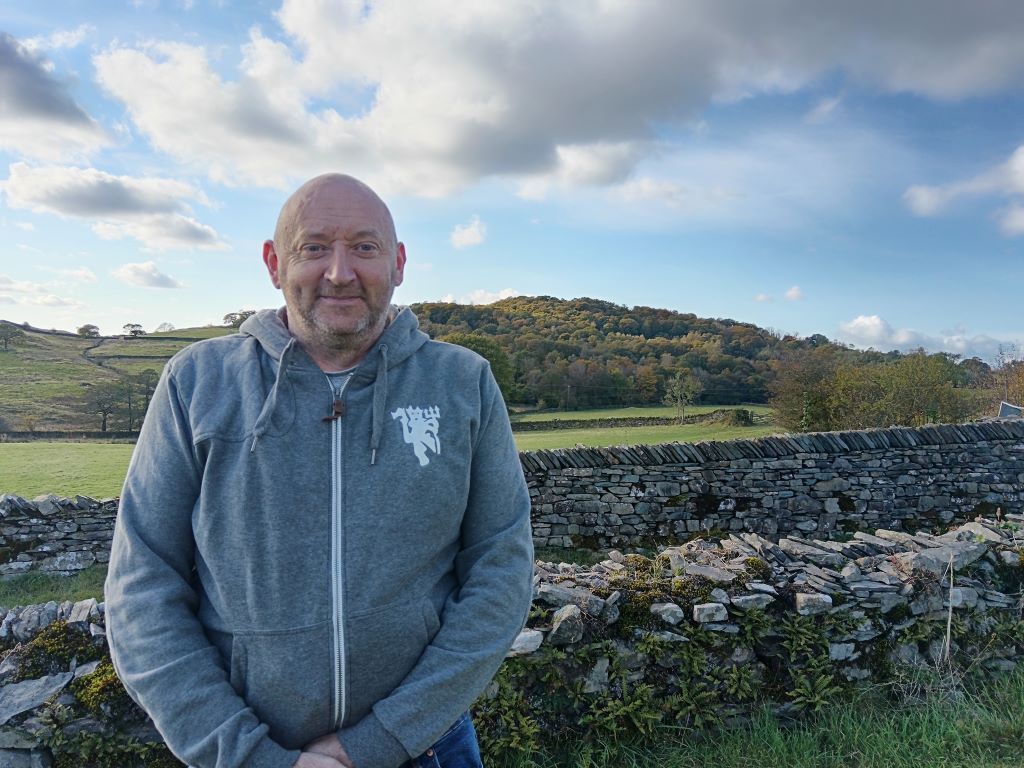
Tenant Phillip Allonby has a herd of 30 Limousin cross and Belgian Blue cross cattle.
Habitat surveys reveal rich and diverse flora in some meadows and potential for further restoration in others says the National Trust’s assistant nature conservation adviser Chloe Lumsdon. She said:
“We’ve found that Grove Farm is wonderfully diverse in different plants with a rare assemblage of grassland fungi species identified in some fields. They include Golden Spindles fungus and Parrot Waxcap mushrooms.
“It could qualify these areas as a Site of Special Scientific Interest, underscoring the farm’s significant and national conservation value.”
Phillip said he attributed the ecological findings to the farm’s long-standing, low-input approach. “I’ve just farmed in the way my father taught me, with a focus on balance,” Phillip said.
His father, Bob, established the family’s farming legacy at Grove Farm in the 1940s and he gained a reputation for raising high-quality Hereford cattle. Phillip officially took over in 1990, before Bob died in 1992.
Phillip said: “I started working alongside dad when I left school. He was ready to slow down at that point, so we had this period where he had to try and give me a lifetime of experience in a very short time. It wasn’t easy, I wish I knew then what I know now, I might have done things slightly differently.”
Phillip has continued farming in the same way, using natural fertilisers and minimal artificial inputs, which he believes has been key to promoting biodiversity.
While Phillip’s main passion is his cattle, he recognises the value of Grove Farm’s natural environment.
He said: “We did use a bit of artificial fertiliser in the past, but mostly we rely on the cows’ manure, which has clearly been beneficial for the plants and fungi thriving here. I still love having my cows and, if I could, I’d have even more of them. But working with the National Trust to explore environmentally friendly schemes is rewarding too.”
John Pring, the trust’s countryside manager in the central Lakes said: “It was about 25 years ago, when National Trust rangers were wardens, that we first discovered the delights of Grove Farm.
“We have been working alongside Philip to improve its ecological status ever since. I’m so pleased with the survey results. Our challenge now is to build on Phillip’s great work and improve the biodiversity on the farm even further,” added John.
As Grove Farm looks to the future, Phillip is hopeful that government support through new agri-environment schemes will allow him to continue this legacy of low-impact, high-value farming.
“I’m excited to keep working with the Trust to add more wood pasture and enhance what we’ve achieved,” he said.
“But there is still some uncertainty because we’re waiting on government decisions regarding these programmes.”