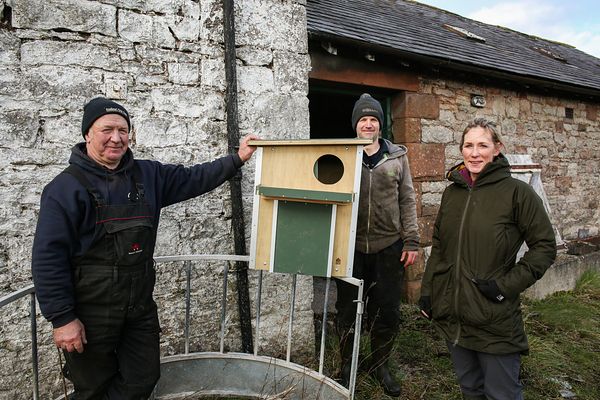
Farmers in the Lowther Valley are on a collective mission to support local barn and tawny owl populations by creating and enhancing habitats across their land.
The initiative, supported by nature recovery programme, Cumbria Connect, has seen 10 farmers come together to create vital new nesting sites, helping to address habitat loss and declining owl numbers.
Through this project, Cumbria Connect funded by the Endangered Landscapes & Seascapes Programme, has provided 20 nesting boxes, with tailored advice on where and how to install them and helping farmers to enhance their land for these much-loved birds for maximum success.
The initiative has focused on installing nest boxes in barns, trees and suitable locations, ensuring safe breeding sites, while also promoting habitat improvements that support the owls’ food sources, such as voles and other small animals.
Annabelle Kennedy, senior farming and wildlife adviser at Cumbria Connect, said: “We’re thrilled to see farmers in the Lowther Valley embracing the opportunity to support barn owls and tawny owls.
“The enthusiasm of the farming community is key to our mission of restoring nature across Cumbria. This project is a great example of how small changes at a local level can have a big impact. By installing nest boxes and managing land with wildlife in mind, farmers in the Lowther Valley are playing a key role in supporting these beautiful and ecologically important birds.”
Barn owls have suffered population declines in recent decades due to the loss of rough grassland and traditional nesting sites like hollow trees and old barns.
By working with local farmers, Cumbria Connect is helping to reverse this trend by working to ensure that these birds have the safe spaces and resources to thrive.
The team has also produced a guide with practical tips on maintaining rough grassland, maintaining woodland and creating in-field ponds to provide prey-rich hunting grounds for owls, as well as advice on how to avoid risks such as secondary poisoning from rodenticides.
Barn owls are well known for their effectiveness at controlling rodent populations.
By encouraging barn owls and tawny owls to establish on their land, farmers can support sustainable pest control while contributing to nature recovery efforts.
The initiative is part of Cumbria Connect’s broader work to support productive nature-friendly farming and habitat restoration across 42,000 hectares of the Lake District and Yorkshire Dales National Parks.
Barn and tawny owls are protected under UK law and their survival depends on safe nesting sites and access to food.
Rough grassland, which provides a home for their prey such as voles and mice, has become increasingly scarce. Cumbria Connect’s work with farmers directly addresses these challenges, ensuring that owls have the resources they need to thrive.
Cumbria Connect is calling on other farmers and landowners to get involved in creating more opportunities for wildlife.
For more information about our owl conservation efforts and other habitat restoration projects, visit www.connectfornature.org.uk or email [email protected].