A petition opposing plans by the NHS to permanently reduce the level of care available at Furness General Hospital in Barrow has been presented to the chief executive of the body proposing the changes.
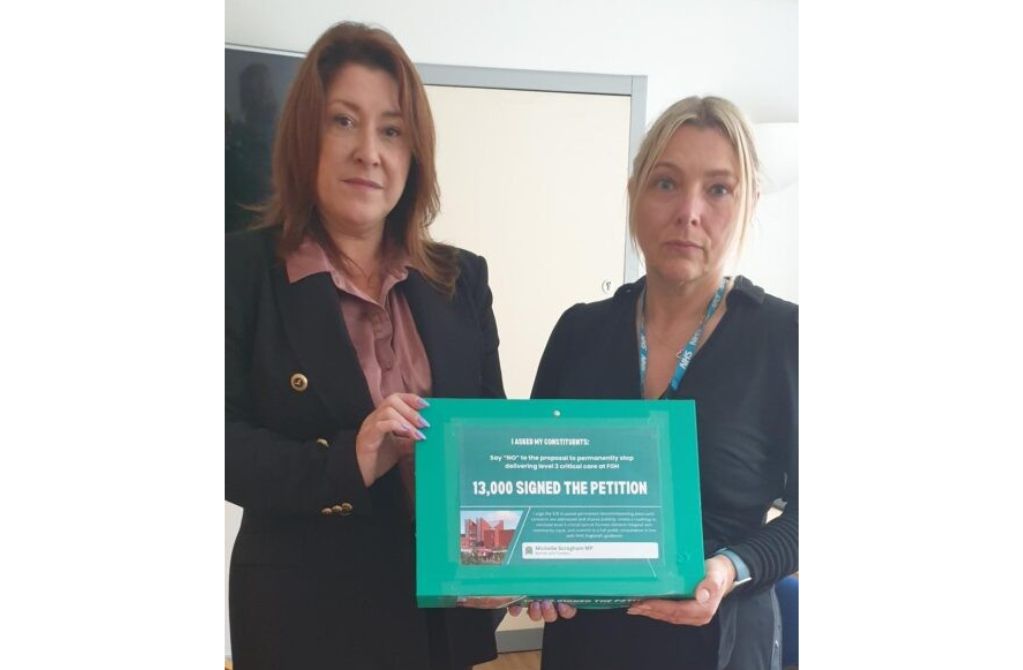
Barrow and Furness MP Michelle Scrogham launched the petition following Lancashire and South Cumbria Integrated Care Board’s proposals to make permanent a suspension of the highest level of care – level 3 – last September.
A lack of qualified and experienced staff was the original reason for the suspension, which at the time was said to be temporary. A review has suggested the change should be made permanent.
The MP presented the petition and met with Sam Proffitt, the acting chief executive of Lancashire and South Cumbria ICB.
Mrs Scrogham said: “I met with Lancashire and South Cumbria ICB to discuss their proposal to permanently close level 3 critical care at Furness General Hospital.
“I presented our petition of 13,300 signatures opposing the plans and set out our concerns including a list of fundamental questions that need answering before any decisions are made.
“I was pleased that the ICB seemed to be listening and that they were keen to stress that no decisions have yet been made. I will continue to make the case and ensure that the voices of clinicians and local people are heard.”
The MP has also submitted a letter to the ICB asking for clarification of a number of issues raised following the report completed by the North West Senate, the NHS organisation which carried out the review:
- Impact on interdependent services including maternity services: The North West Clinical Senate expressed concern that interdependencies at FGH
(maternity, acute paediatrics, full A&E) have not been fully assessed. Other stabilise-and-transfer sites across the country do not run these services. Please
provide the analysis that has been undertaken of the impact on interdependent services at FGH, and what actions have been taken to address these. - Sustaining Level 1 and 2 care: The Senate warned that removing Level 3 care could undermine Level 1 and 2 provision. Please publish your assessment of
this risk and the plans you would put in place to ensure these services remain viable. - New service model: The NW clinical panel’s conclusions were subject to the commissioner and provider defining the new service model for stabilisation and
transfer of patients with level 3 needs – has this new model now been provided to the Clinical Senate? - Recruitment: Recruitment challenges have formed the basis for your decision. Please now publish a detailed account of the recruitment strategies that have
been used to try and fill the vacant posts. - Prioritisation of RLI: Given Barrow’s geographical isolation, was consideration given to reducing capacity at RLI to maintain the service at FGH? Please share
details of the analysis undertaken which led to RLI (which is close to other ICUs) being prioritised over FGH? - Demand modelling: What methodology was used to forecast future Level 3 demand in Furness given the projected population rise for the area, and did it
account for seasonal surges, major incidents, or changing population health? Please publish your modelling so that it can be independently assessed. - Outcome data: You refer to improved outcomes under the temporary arrangements. Please share the detailed comparative figures (mortality,
morbidity, length of stay) for the periods before and after the temporary downgrade. - Transfer risks: What evidence did you use to assess the effect of the transfer to RLI on outcomes in time-critical cases, especially during poor weather or A590
closures? Please share the assessment that has been made of this. - Critical mass: You argue that low patient numbers prevent safe maintenance of Level 3 skills. Can you confirm how this “critical mass” is being defined? How do FGH and RLI perform against these levels?
- Impact on patients and families: Has a full equality and health inequalities impact assessment been completed, particularly regarding Barrow’s socio-
economic challenges and longer travel times for relatives. Please publish your assessment. - External expertise: The Senate recommends that external expert advice and support is needed for this change. Will the ICB insist on this being provided
before decommissioning is approved? Should we ask if they have ascertained this already? - Public consultation Please publish the minutes from the decision-making meeting when it was decided that the threshold for full public consultation has not
been met in this case. How will the ICB ensure meaningful, transparent engagement with the public and local clinicians before any decision is made?
Cumbria Crack has approached Prof Martin Vernon, of the North West Clinical Senate, who compiled the report for comment.
A consultant working at FGH has shared their concerns about the proposed changes with Cumbria Crack.