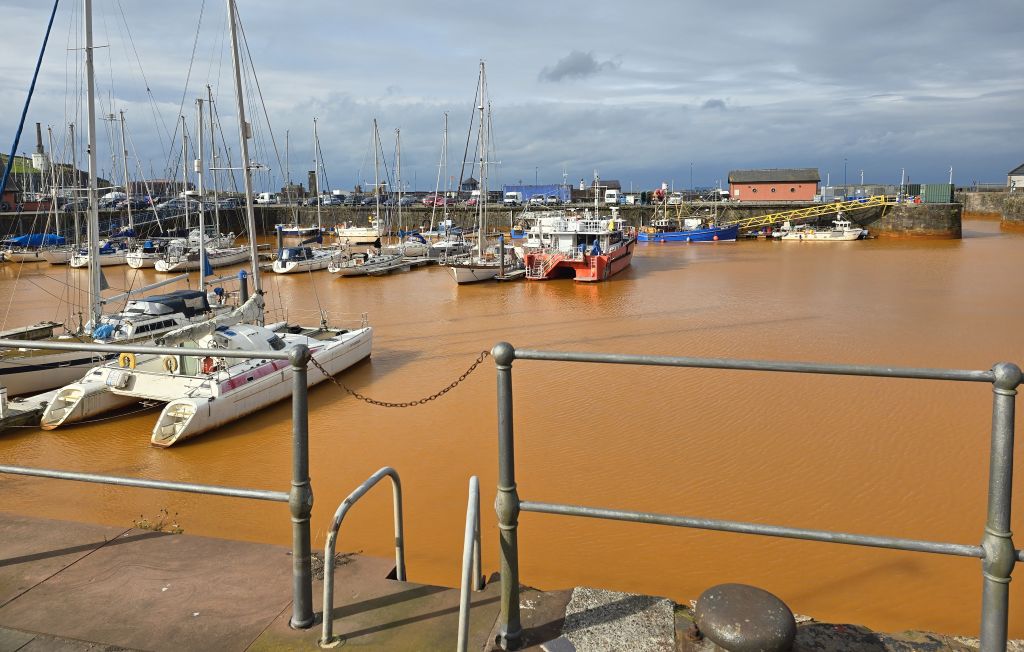
Plans have been approved to divert Whitehaven Harbour’s orange water out to sea.
The Harbour Taskforce, chaired by Josh MacAlister MP, met last week to approve the idea as a solution to restore the harbour to its natural state.
It has come after an extensive feasibility study, which confirmed that diverting the water out to sea is the most viable option.
Mr MacAlister is now set to meet with Ministers to secure the £4 million funding needed to deliver the scheme.
In order to divert the water, a new pipeline will have to be built to divert the water away from the culvert and along and through the harbour wall where it will be released into the sea on the foreshore north of the harbour.
Local stakeholders will now have to work quickly to agree ownership and governance arrangements for the new asset so that the work can begin without delay.
Mr MacAlister said: “The development and approval of this plan is meaningful progress the people of Whitehaven have been waiting for. For three years now our harbour has been tarnished by the orange discharge.
“While investigations continue to locate the source of the water, we may never know, and so we have to focus on diverting it safely.
“I will now take this to Ministers and demand the funding to get on and build it. But success also depends on local partners stepping up: we must agree who owns and maintains the new system so that it is delivered, sustained and trusted.
“The people of Whitehaven deserve nothing less.”
The Harbour Taskforce will continue to lead the way on plans to divert the orange water out to sea.
It is made up of Whitehaven Harbour Commissioners, Cumberland Council, the Mining Remediation Authority, Environment Agency, Network Rail, Whitehaven Marina Limited, The Coal Authority, Whitehaven Town Council, Clean Rivers Trust, Co-Lab Engineering, Sellafield Ltd and Forth Engineering.
The orange water was found entering the harbour through a culvert in Queen’s Dock which which was confirmed to connect to the Bransty rail tunnel drainage system.
Despite investigations, the cause of the colour change remained unknown for around a year, before tests found the found floodwater from the rail tunnel contaminated with iron ochre – a byproduct of historic mine workings – as the cause of the harbour turning orange during periods of heavy rain.
Despite this, pinpointing the source of the contaminated water still remains a problem and investigations have so far have proven inconclusive.
In July, we revealed that the orange water was actually visible from space.
The European Space Agency photographed the town – and the rest of Cumbria – as part of its Copernicus Sentinel-2 mission.