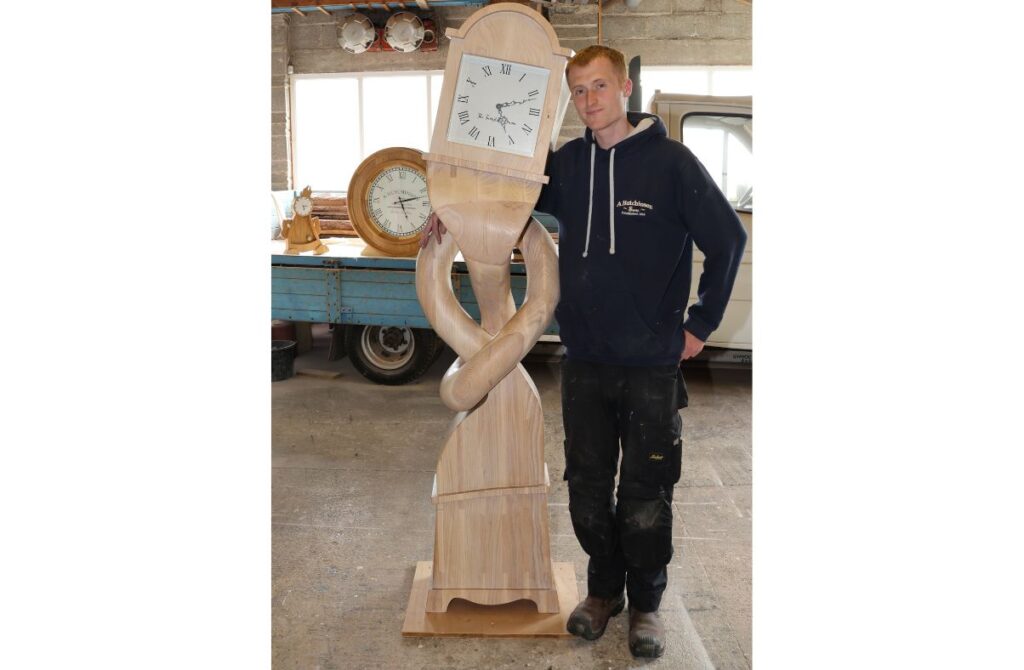
It could be a prop in a Disney animation, Alice in Wonderland perhaps, or most definitely Beauty and the Beast, writes Ian Lamming.
Standing resplendent in a Cumbrian workshop, towering more than 6ft 8in tall and 12st in weight, with not a single edge parallel to any other, is a grandfather clock with a twist.
Carved from a single block of ash, with a chainsaw of all things, the piece appears entwined, to kink and curl into a series of knots that would make a sailor proud.
The latest masterpiece of joiner-cum-craftsman Robbie Hutchinson has been, like his other work, collecting the prizes at innumerable shows.
The family business of A Hutchinson and Son was founded in 1959 in Levens, near Kendal, by his granddad Alan, a joiner-cum-undertaker.
Robbie now runs it with his dad Chris.
While their workshop features meticulously piled wood, neatly hung tools and impressive machinery, the fruits of the day job being high quality, handmade doors and windows, there are also signs of Robbie’s passion for cabinet-making.
When he was a child, he started creating model farms with wood cut by his father, gluing them together, with most of these now residing in the attic.
Robbie joined Young Farmers and entered the joinery competitions staged at the annual field days, his first entry of a model farm coming second.
A wheelbarrow followed made from sapele, a hardwood that is difficult to cut because the grain goes both ways. It took first place at Cartmel Show.
After leaving Dallam School, Milnthorpe, he joined the family business in 2010, the same year granddad Alan died, and was instructed further by his dad, working by day on anything required by the building trade and after hours creating more fine furniture.
Next a unique rack featured wooden cylinders for the wine arranged around a solid bottle.
An intricate chopping board, of walnut and tulip, oak and sapele, formed a 3D optical illusion.
A large wooden clock used solid oak with tulip segments to show the time and a miniature French street light, again made of oak, impressed judges so much he only lost a single mark for not hiding away the cable.
Robbie even won the Young Farmers’ National Pallet Challenge by making a rocking chair and table in just an hour from the rough wood.
Now 30, Robbie remains constantly up for a challenge the latest being inspired by renowned sculptor Alex Chinneck.
“I had done previous clocks and was at my godmother’s, Gail Middlebrough, when she showed me knotted pieces of artwork – I thought they were incredible,” says Robbie. “She said I should try making a grandfather clock in the similar style, but I thought it was out of my league.
“I was making a 10.5st Shaker Garrett table at the time, which took me about 230 hours, and she said if my table went well at the shows I should think about doing a clock. The table went on to get four best in shows which gave me the confidence to try.
“So I started by doing a drawing, which was difficult in itself because I’m not that great at sketching. I showed this to my godmother and decided to go for it.”
The next step was making a scale model of the twisted clock, a miniature version to see if it would be possible.
He says: “If I couldn’t do it on a small scale then I wouldn’t be able to do a larger version. The model proved it was possible so I knew I could scale it up. I also used the toy to work out the weaknesses and areas that could be improved, such as the fact I’d separated the knot forming a weak point, and it gave me an idea how to do a bigger one.”
The largescale clock began life with 12x3in wood sections glued together into a single block.
“It had to have one mind, go in one direction,” says Robbie, “otherwise the wood fights against itself and there’s a high chance of it cracking.
“A lot of drawing then went on the block but ultimately you have to just stand back and go for it, dig in with the chainsaw and pray.
“I would do the cut then go home and start fresh the next day. You couldn’t spend an entire evening doing it as it would confuse you where things should be. One wrong move and it would have been game over. In the end I had one small split I had to rectify which is good going.”
Robbie then used an angle grinder with a special cutter designed for carving. “This was an excellent tool and I couldn’t have done it without it. You use it to make the sweeps, then it was a case of using hand tools to fine tune the curves.”
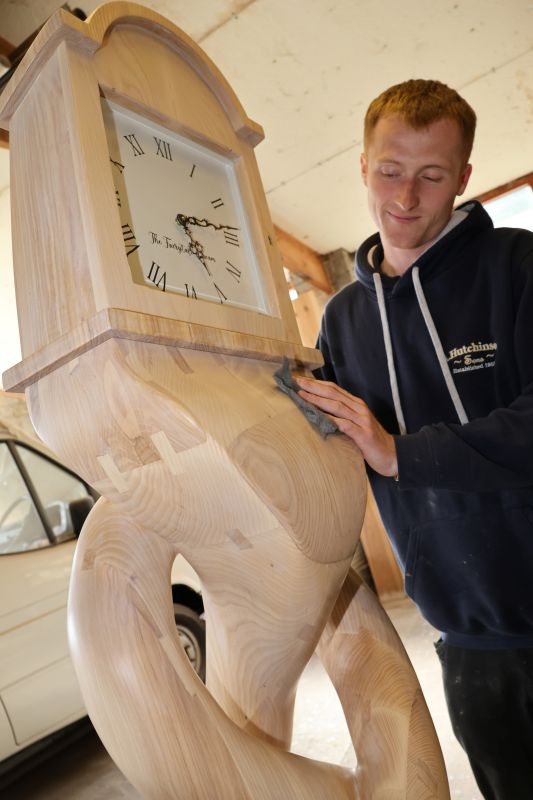
Finally, it came down to hand sanding, starting with 60 grit paper, followed by 100 then 150, finishing with 240.
“It took longer to sand than it did to make,” recalls Robbie. “It was rough after the angle grinding and the wood is hard so I downloaded documentaries from Netflix to watch while I was sanding and that got me through.
“Coats of clear varnish protect the wood but even after it was finished I had to glue some extra strips on the rear door to the movement as it had shrunk in the heat.
“The head is twisted 1.5in from the base and it’s hard to do something that isn’t square or straight when you are used to making everything so straight to the millimetre.
“I didn’t think it would take me longer than the table, 200 hours, but how wrong was I? It actually took 327 hours to complete, that’s seven months of nights and weekends and there weren’t many nights that I wasn’t here.”
First place at this summer’s Country Fest in the woodwork section proved it had been worth the effort. “There were crowds of people round it,” he says. “I’ve never created anything that attracted so much attention.
“I was surrounded and it put a smile on so many people’s faces. Children came up and said ‘wow’. It was an amazing weekend.”
The clock was also the centrepiece at Penrith Show’s Fairytale Dream. “It was the ultimate dream and people thought it looked like something out of Alice in Wonderland or Beauty and the Beast,” he says.
If it was for sale, the wood itself cost £860 but the labour would add around £11,000 to the price.
It now stands proud as a company flagship. “It just shows the attention to detail we have in our work and that people can put their trust in us,” says Robbie.
“I’m happy to put in a full day’s work for our customers then come back to the workshop at night to do my own bits.
“But I’m equally happy now to take a tiny break from the cabinetry and concentrate on the business, though I do wonder what my godmother will challenge me to do next!”