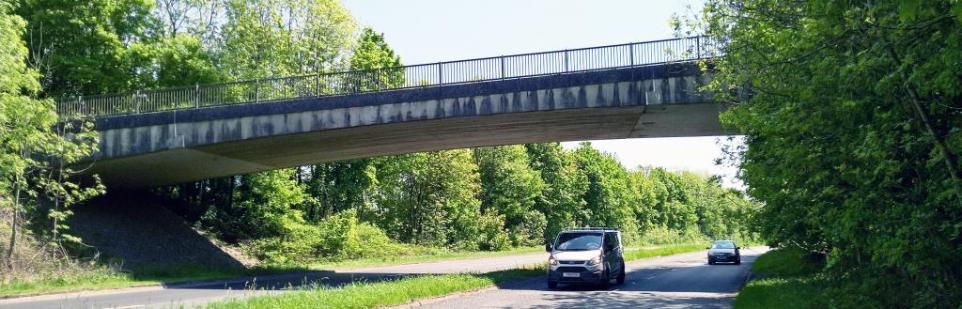
Drivers are warned that they are committing a criminal offence and risking lives by ignoring weight restrictions on two Cumbrian bridges.
Brigsteer and Underbarrow bridges, which run over the A591 near Kendal, were initially closed as a precautionary measure due to structural concerns.
An external expert report commissioned by Westmorland and Furness Council recommended a closure on both bridges to allow for further detailed assessment and monitoring.
After detailed analysis, the bridges opened under a 7.5 tonne weight limit in February.
Signs were erected for a diversion and drivers of vehicles over 7.5 tonnes gross weight are required to use the alternative route.
The authority said Cumbria Constabulary was aware of the situation and have been conducting checks with marked and unmarked cars.
Failure to comply is a criminal offence which may result in prosecution and/or a fine.
The council has also put in place enhanced monitoring, it said.
Councillor Peter Thornton, Westmorland and Furness Council’s cabinet member for highways and ICT, said: “Safety remains the top priority throughout this essential process while also maintaining access for most vehicles.
“Anybody contravening these restrictions is putting themselves and others at risk. This enhanced monitoring will give us a clear picture of whether drivers of vehicles over 7.5 tonnes are continuing to use these bridges. If these contraventions continue then we will have to review the situation and the options available to us.”
Brigsteer and Underbarrow are reinforced concrete half joint bridges that were constructed in the 1970s.
This type of bridge requires and receives bespoke and detailed assessments that are carried out by an external consultant across an extended period of time, to ensure they benefit from ongoing continuous review in line with national guidance.
Detailed investigations confirmed there were no signs of significant deterioration on both bridges following the council’s ongoing safety assessments and maintenance.
The required weight limits are due to a design issue with half-joint structures constructed in the 1960s and 70s; a problem seen nationally.