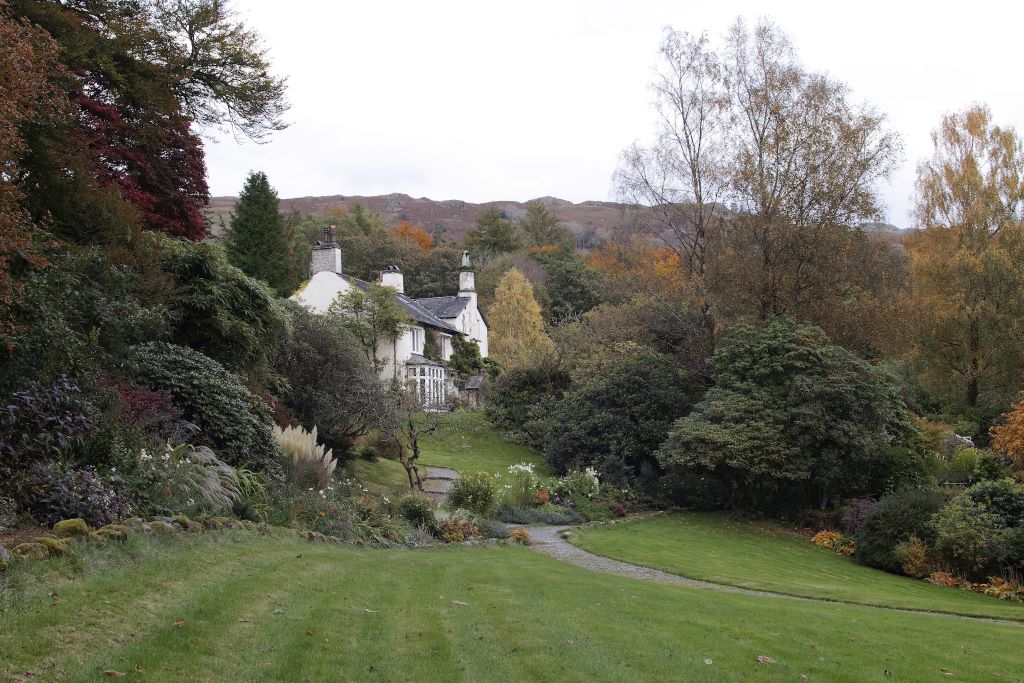
When the descendants of the poet William Wordsworth finalised the deal to sell his former Lake District home to the Wordsworth Trust, an author breathed a sigh of relief – and finished writing the final chapter of her book.
Rydal Mount: The Story of Wordsworth’s Home had been under way for 12 months, a history of the house but more than that, the stories of the people who lived there, worked there, wrote poetry and played music there, and the author’s own night there, sleeping in William Wordsworth’s bedroom.
During that time Rydal Mount had been put on the market, reluctantly, by the great-great-great-great-grandsons of the poet who had inherited it from their grandmother some 30 years earlier.
Mary Henderson, bought the house in 1969 as both a family home and a visitor attraction; when William lived there, he had rented the place.
Wordsworth, the greatest of the Romantic Poets, lived there for most of his life, from 1813 until his death in 1850.
It was from here that he published the definitive version of what is possibly the world’s most famous poem, Daffodils, where he became an accomplished landscape gardener, hosted many dignitaries and celebrities of the time, and was appointed Poet Laureate.
The house became in recent years a popular tourist attraction.
But Rydal Mount was an increasing financial burden, when visitors numbers dropped sharply after the pandemic lockdown, and with brothers Christopher Andrew and Simon Bennie both living in London and unable to maintain the house on a daily basis.
They always hoped that the Wordsworth Trust, a charity with access to various streams of funding, would be able to buy it, and keep it for the nation alongside Wordsworth’s other home, Dove Cottage in Grasmere, and when that happened – in March this year, with thanks to the Julia Rausing Trust and the Charlotte Aitken Trust – the last chapter of Eileen Jones’ book was finalised.
She’d planned to call it A happy ending, but Sally, Simon Bennie’s wife, pleaded that there was also some sadness among the family on losing their home, and suggested instead A new chapter.
The book had been planned a number of years earlier. Jones worked with the Wordsworth family and the various curators at the house for more than a decade, publicising and promoting Rydal Mount as a tourist attraction and helping to organise events there.
She said: “I realised the privilege of the insights I was given, spending time with a remarkable family in a very beautiful house, and back in 2019 I started to write a book, completing just one chapter.”
The Wordsworth family had agreed to help, but at the time were too busy. And then lockdown happened, the house was closed, and that one chapter disappeared into a folder on Jones’ desktop.
Six years later, and with three other books now published under the Gritstone imprint, Jones was asked by colleagues at the publishing co-operative what her next project was going to be.
Eileen added: “The news had just broken about Rydal Mount going up for sale, and I had vague memories of having started something.”
She found that first chapter, and with it some restored and vivid memories of sitting in the day room with Susan Andrew, the poet’s 3 x great granddaughter, and Gina Wordsworth, and a dog called Barney who was sitting in the fireplace alarmingly close to the logs.
Gina (nee Rothschild), the widow of William (Bill) Wordsworth, a great-great-grandson, had since died.
Eillen added: “And I knew I must start writing again, while there were still people to help me with their memories.”
Key among those were Peter and Marian Elkington, former curators who lived in Rydal Mount for 25 years before retiring back to their native South Africa.
Their stories are illuminating, a fascinating insight into life in an historic property, and the hard work required to encourage tourists and poetry fans to visit. They were hugely successful, and there were eventually coachloads of visitors daily, often from Japan, China and the USA.
There were famous visitors, too, film stars and writers and musicians, and on one occasion in the 1970s, before Peter and Marian’s time, a pageant of beauty queens in the Miss UK contest, accompanied by the dance troupe Pan’s People who performed on the lawn in front of the house.
Eileen added: “Peter was sure he’d seen photos of them, and indeed, we discovered them, pictures of them dancing clad appropriately in daffodil yellow.”
In recent times the Wordsworth family were often on site, painting and decorating, hosting dinners, helping out in the tearoom and at Christmas fairs, and – of course – reading poetry to groups of enchanted Wordsworth fans.
Charlotte Wonter, Christopher and Simon’s cousin, who is a film producer, launched a film festival in partnership with the local cinema, Zeffirellis, The Inward Eye, with writers’ workshops held in Rydal Mount.
Eileen added: “The book makes no claims to literary criticism or full biography of the poet, the leader of the Romantic movement, environmentalist and energetic hiker, though there is detail about William Wordsworth’s life there, his wife Mary, his immensely talented sister Dorothy. Instead, it delves into the life of a remarkable house over the centuries.”
Christopher said: “Here’s a look behind the scenes at our family home which has also been one of the best loved heritage destinations in the Lake District for more than half a century. We hope you will love Rydal Mount as much as we have done.”
Contents from Rydal Mount are due to go under the hammer at Mitchells in Cockermouth next week.