
Cumbria has officially entered a new era of summer heat, with temperatures now pushing well beyond anything the county saw in the late 20th century.
The clearest sign came in July 2022, when Carlisle clocked a blistering 33°C — the hottest day ever recorded in the county — and confirmed what many already suspected: the old rules about Cumbrian summers are gone.
Over the past 50 years, Cumbria’s climate has shifted from reliably cool and maritime to one where heat spikes are now routine, not rare.
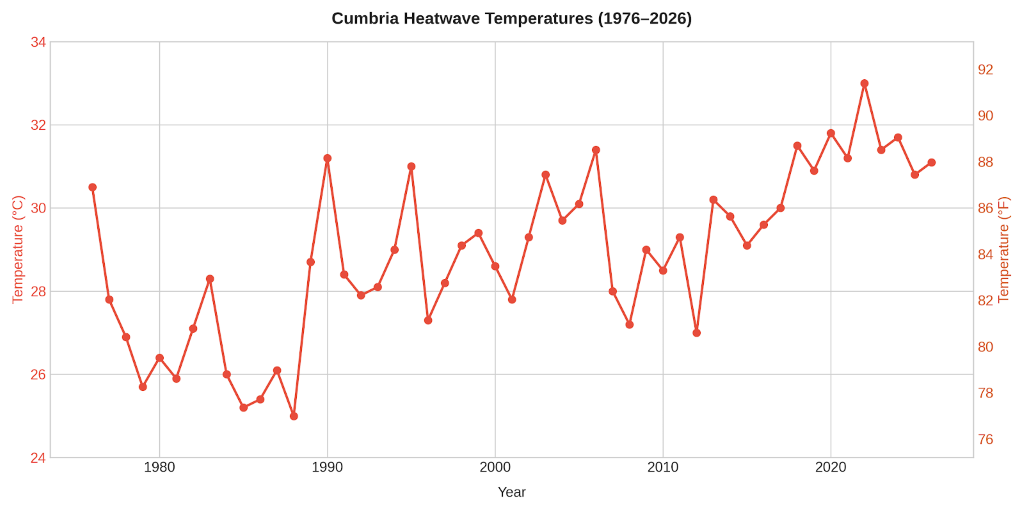
In the late 1970s and early 1980s, the hottest day of the year usually sat somewhere in the mid‑20s.
Even the summer of 1976, remembered for dried-up becks and scorched fells, peaked at around 30°C — hot, but still within the bounds of what locals considered unusual rather than alarming.
By the 1990s, the pattern had begun to tilt.
Carlisle and the Eden Valley started hitting 31°C in strong summers like 1990 and 1995, and those peaks weren’t one-offs.
The 2003 European heatwave nudged Cumbria higher again, followed by 31.4°C in 2006, showing the county’s ceiling was rising fast.
The real acceleration came in the 2010s. Summers such as 2013, 2018, and 2020 delivered repeated bursts into the 30–32°C range, with hot spells lasting longer and arriving earlier.
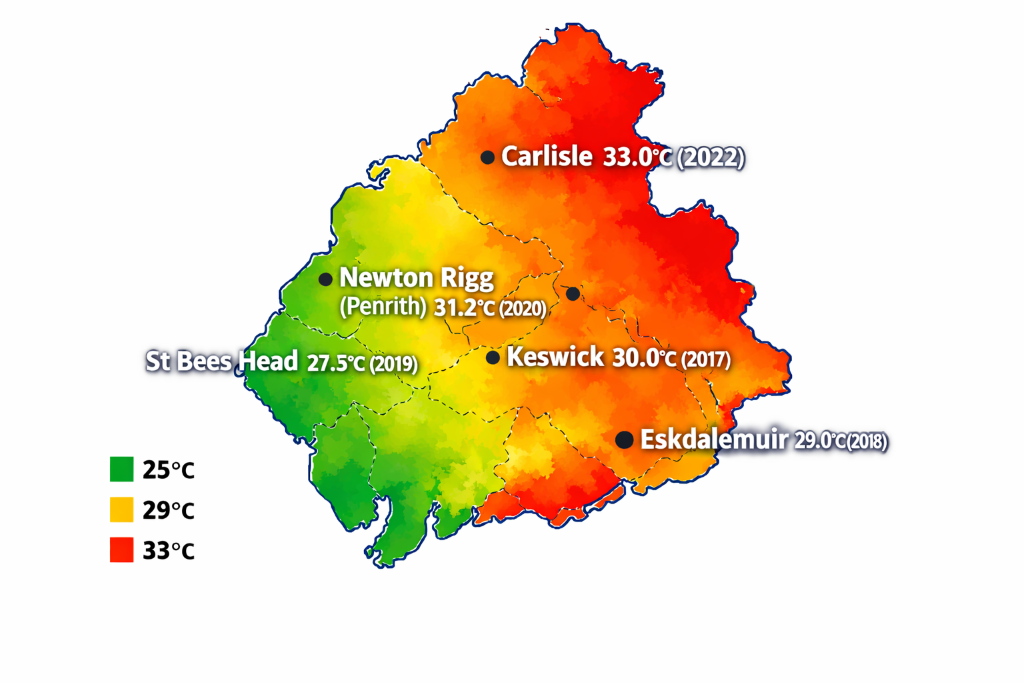
Then came 2022, the year Cumbria set its modern record. As southern England smashed national highs, Cumbria quietly logged its own milestone: 33°C in Carlisle, the hottest day the county has ever recorded. It wasn’t a freak event — it was the peak of a clear, decades-long climb.
Today, Cumbria’s temperature story isn’t about the odd hot day. It’s about a county warming steadily, year after year, with heatwaves now part of life from the Solway to the South Lakes.
Key monitoring stations — Newton Rigg, Keswick, Eskdalemuir, and St Bees Head — all show the same upward trend.