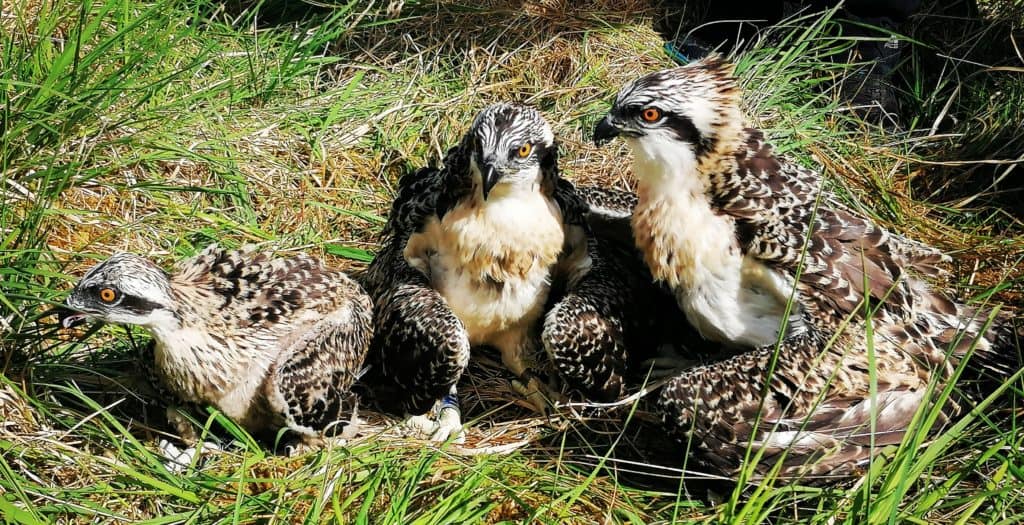
A centenary of osprey chicks have now been tagged in Cumbria as the latest three are given their ID rings at Foulshaw Moss Nature Reserve.
The nature reserve, located near Witherslack in south Cumbria, is one of the county’s key breeding sites for these spectacular birds of prey.
It was a key moment in osprey conservation, marking the 100th osprey chick to be ringed in Cumbria since 2001.
Paul Waterhouse, reserves officer for Cumbria Wildlife Trust, visited the nest site to accompany a licenced and experienced bird ringer brought in to tag the chicks with ID rings.
As the osprey is a Schedule 1 protected species, only those with a licence from the British Trust for Ornithology (BTO) are permitted to approach and handle the birds. The parent birds kept a watch on the wing as the three chicks were carefully lowered from their tree-top nest.
Paul Waterhouse said: “I’m incredibly pleased that we have ringed another three osprey chicks at Foulshaw Moss Nature Reserve this year. For a time we we’re unsure if the smallest chick was going to make it. It was rapidly being outgrown by its bigger siblings but it carried on fighting for its share of the food from mum and dad.
“Now there’s not much difference in weight – and it was the smallest one that was the 100th osprey chick to be ringed in Cumbria since 2001. Osprey chicks are weighed by the licenced bird ringer and each chick is given a coloured leg ring. This year we have Blue 462, a female weighing 1.6kg, Blue 463 weighing 1.5kg – gender unknown, and Blue 464, a male weighing 1.6kg.
“These tags are invaluable as they enable us to identify the birds individually, keep tracks of their movements and understand their life history. They have been fitted with metal BTO rings, as part of the national bird ringing scheme and also a plastic colour ring, which allows individual birds to be identified in the field using a telescope or telephoto camera.”
Chicks doing well
All three chicks are doing very well. As fully-grown adults their wingspan will be around 152cm–167cm (about 5 feet), making them one of the largest birds of prey in the UK.
The osprey chicks are expected to fledge in the next couple of weeks and will fly the nest at the end of summer, before they start their hazardous first migration to southern Spain or west Africa. Until then, you can continue to watch their progress on Cumbria Wildlife Trust’s osprey webcam.