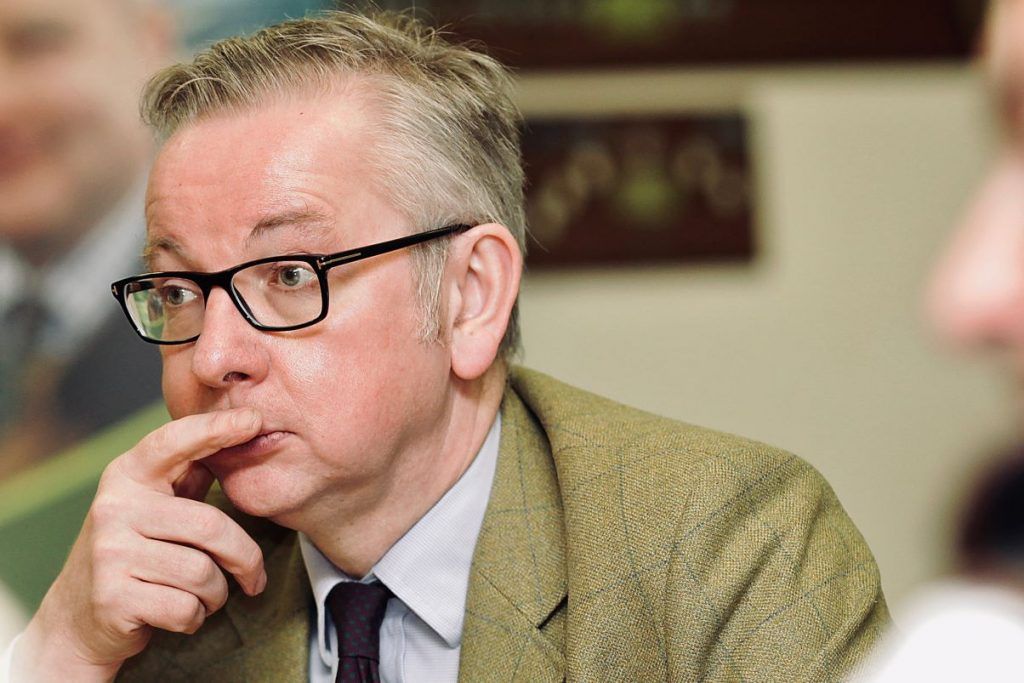
As the Public Inquiry into plans for an £160 million coal mine off the coast of Whitehaven is in its second week, a cabinet reshuffle means Michael Gove is likely to make the final decision about whether it can go ahead.
West Cumbria Mining’s planning application – despite being approved three times by Cumbria County Council – were called in by Housing, Communities and Local Government secretary Robert Jenrick after concerns over climate change and the UK’s commitment to reducing carbon emissions.
Planning inspector Stephen Normington will make his recommendation to the Secretary of State after he has weighed up the evidence of the inquiry, which is expected to last four weeks.
Until yesterday, that would have been Mr Jenrick. But he lost his job in Prime Minister Boris Johnson’s cabinet reshuffle yesterday and has been replaced by Michael Gove.
The inquiry, being held online due to COVID-19, has already heard from Mark Kirkbride, the chief executive of West Cumbria Mining, politicians, interested third parties, representatives of South Lakes Action on Climate Change and Friends of the Earth and experts in economics and the need for fossil fuels.
West Cumbria Mining said the coking coal mine, called Woodhouse Colliery, would be the world’s first net zero mine.
This claim is disputed by climate change activists.
West Cumbria Mining told the inquiry that it would offset emissions with carbon credits from The Gold Standard Foundation.
Carbon credits are measurable reductions in emissions by climate projects which offset the impact of other activities.
But in a letter to the mine’s opponent, Friends of the Earth and the planning inquiry, The Gold Standard Foundation said: “The latest scientific paper from the Intergovernmental Panel on Climate Change on August 9 gave a stark reminder of the pace at which the planet is warming and the unequivocal influence of human activity on this warming, in particular the extraction and use of fossil fuels.
“We note that achievement of the goals of the Paris Agreement would be rendered impossible by the already planned increase in fossil fuels (UN Production Gap Report, 2019), and that the International Energy Agency has clearly stated that further investment in fossil fuels is unnecessary, with achieving global net zero goals instead requiring a rapid reduction in their use.
“It is clear to us, in light of this evidence and reflecting the principles of the mitigation hierarchy, that a new coal mine in 2021 is an activity that must be avoided in the context of the climate emergency.”
Friends of the Earth climate campaigner Tony Bosworth said: “This is yet another huge gaping hole in West Cumbria Mining’s case for a new coal mine.
“Gold Standard, whose offsets the company plans to use to try to greenwash its activities, says it opposes the mine and that plans to offset just part of its climate impact should not be used to let it go ahead.
“This disastrous new project would help to fuel the climate crisis. With dire scientific warnings on catastrophic climate change still ringing in our ears, and crucial climate talks only weeks away, it beggars belief that the UK is still considering plans for a new coal mine.”
At the inquiry on Tuesday, Jim Truman was called on to give evidence by West Cumbria Mining’s QC Gregory Jones.
Mr Truman, coal expert for WCM’s analyst Wood McKenzie, explained how cuts to emissions would be achieved.
He said: “The Intergovernmental Panel on Climate Change has produced emission levels that they have determined will meet the restriction of temperature growth to either 1.5 or 2.0 degrees Celsius warming. They have provided those targets for emissions globally.
“Our energy transition team has looked at, evaluated those numbers, used those numbers as a starting point and has made a decision for us to meet those reductions.
“(Deciding) How much emissions would be required, what those levels would be for each of the main sector involved where the Carbon emissions come from so they allotted a certain number in 2050 for our steel team.”
Mr Truman said: “The reduction in the 2.0 case is about 75 per cent and the reduction is in the order of 95 per cent for the 1.2 case. Our steel team then has taken those points and then determined that they have that allotment of emissions to deal with, and so one by one that team looked at the most efficient ways to start first at the top, the most efficient ways to make large cuts in emissions.”
He said that the main method for this is prioritising the recycling of scrap and increasing the use of electric arc furnaces, which are kinder to the environment than blast furnaces.”