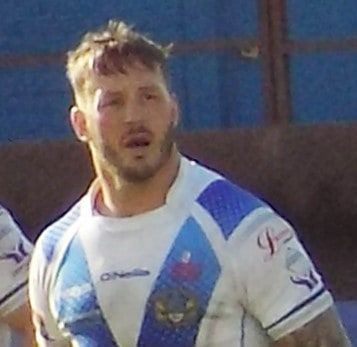
Cumbrian forward Ollie Wilkes, who retired in 2019, is the latest former pro player to admit to taking banned substances during his career.
Ulverston-born Wilkes, 41, was captain of Workington Town when he retired from playing in 2019 after the Derwent Park club was the 11th different club on his CV.
During his 21 years in the sport, totalling over 500 games, he played for all three Cumbrian clubs – Whitehaven (6), Barrow (51) and Workington (45).
He has been speaking frankly to ITV about his time in rugby league and the doping he was part of, and which he says is a major problem for the sport.
Jamie Acton, another former professional, has only recently spoken out about doping in rugby league in the hope that it can be dealt with.
In the ITV interview, Wilkes says he crossed the line a few times but was never caught. There were others who escaped sanctions throughout their careers.
Wilkes says he first crossed the line during an off-season, seven years into his career when he was training with Whitehaven at the time.
“I signed for Whitehaven and I was only training two times a week, and they’d offered me alright money and I thought to myself, I was like: ‘Should I have some, see what all the fuss is about?’
“So I tried a performance-enhancing drug, a banned one, and six weeks into the season I got a phone call off Wigan, to sign for Wigan. And, uh, I thought to myself: ‘Well’, I thought: ‘It worked.’
“Where I grew up the nearest big club was Wigan. I grew up as a Wigan fan and when I got the phone call that day, it was like all my dreams come true.
“Did I feel guilty that I had taken something, that was illegal in sport? Or was it like: ‘Well about time’?
“You know, I didn’t know. I didn’t know what to think. It’s like: ‘Well, it’s, it’s got me there or did it?’
“I was going to be playing that well that year to get seen and picked anyway, I don’t know, but I know I was bigger and stronger.”
Wilkes claims doping took place at a number of the clubs he played for, however, there is no suggestion that the clubs were aware of his actions.
In the interview with ITV, he says: “I used to see people who I was as good as, then all of a sudden come back after a pre-season and they were massive and then just see ’em absolutely tear it up.
“They were quite slow at the start of pre-season, just a bit heavy and then shred up a bit. I assume they’d be clean by this point and avoided being caught.
“At one stage I thought to myself: ‘How am I going to compete with that person knowing they’re doing what they’re doing?'”
Growth hormones and peptides
He says the drugs of choice were growth hormones and peptides (which increase muscle growth) which players believed to be undetectable.
They took them variously to lose weight, aid recovery from injury or allow them to train harder and for longer.
Jamie Acton was only 27 when he retired after the London-born forward had played for seven different clubs including Workington Town (23 times) in 2013.
He recorded a lengthy video message on his Instagram account in which he detailed how drugs had affected his life, and how he felt authorities went to great lengths to keep drug use quiet. He was later contacted by almost 50 players.
Both Wilkes and Acton say they have spoken out so that young men faced with the same temptations that once confronted them will choose a different route and ask for help.
In a statement to ITV News, the Rugby Football League (RFL) said it is “committed to rugby league being a clean sport.
“The RFL condemns drug use in sport as doping is harmful to the core values of rugby league. It is damaging to players’ health and wellbeing, the fairness and integrity of the competition and prevents all from the right to participate in a doping-free competition.”
ITV News also say they contacted both Wigan and Whitehaven for a response.
Have you read?
- Plans for massive West Cumbrian solar farm approved by government
- £450,000 cannabis farm found in Kirkby Stephen
- ‘Respect Wasdale or don’t come’: Crackdown on outdoor anti-social behaviour in Lake District valley
- PC faces criminal probe after teens hit by police vehicle
- St Bees footpath section likely to be closed until 2028