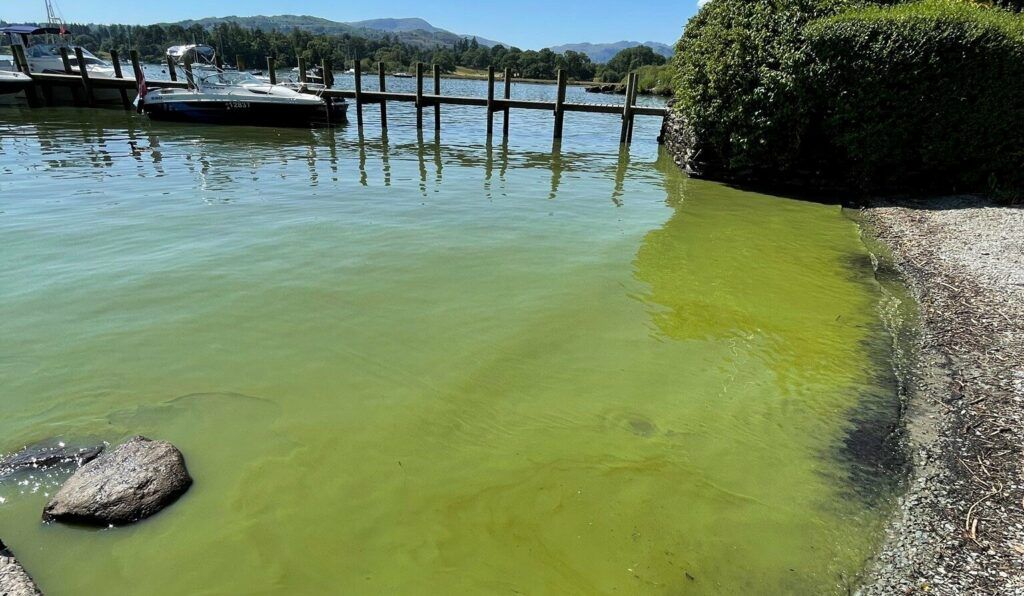
An expert has called for more testing after a sample from Windermere was found to be as toxic as cobra venom.
Dr Nick Everall, a director of AquaScience Consultancy tested the sample and said toxic blue-green algae blooms that pose a risk human and animal health had been found in the water.
The algae concentration in the 500 millilitre sample taken from the northern basin of the lake was found to be several times higher than the Environment Agency and the World Health Organization’s warning threshold levels.
The test was organised by campaigner Matt Staniek, director of Windermere Lake Recovery CIC, who fears that Windermere is dying.
Dr Everall said that weight for weight, the algae was just as toxic as cobra venom and if ingested in large quantities, could cause death, but that one sample was not enough to classify the whole lake as toxic.
He said: “The levels recorded may or may not be typical of the whole water body and more samples would be required to verify that.
“It’s not right to scaremonger and say the whole of the lake is dangerous, but the levels that we have found in the sample are concerning.
“You would have to test the whole of the lake to make that statement, but the area that has been tested is not safe for humans or animals, this includes pets, as dogs often lick their coats and ingest more by doing this.”
I got a Cyanobacteria bloom tested as I felt this wasn’t being taken seriously enough.
— MattStaniek (@MattStaniek) August 22, 2022
It exceeded WHO guidelines for levels of Anabaena. On a weight for weight basis the neuro and hepato toxins potentially produced are as toxic as cobra venom.
Windermere is not safe ⬇️ pic.twitter.com/7XT7ollcMn
Dr Everall added that a human would have to drink straight from the area with the toxic algae for the water to be fatal.
He said that small amounts ingested through water contact sports, such as swimming and paddleboarding, were likely to cause nausea, diarrhoea and skin rashes.
He continued and said that while not all algae blooms are toxic, studies carried out in the 1970s and 80s found that 70 per cent of blooms tested were confirmed to be toxic.
Testing for toxins costs around £400 per sample and daily testing would have to be carried out to establish the overall danger the lake poses to human health, as the toxicity of blooms can change back and forth over 24 hours.
Matt recently spoke out to say he believed the lake is dying and set up a petition calling for more investment into sewage and septic tank infrastructure and increased monitoring of the lake. The petition now has 140,198 signatures.
He added: “In many respects I wasn’t surprised at all by the test results, I felt like it was not being taken seriously enough so I organised the testing.
“I believe the lake should be closed to swimmers if people’s lives are at risk, why should they be aloud to go in the water?”
Matt said that in the area of the north basin, signs have now been put up to warm those taking to the water of the algae, but that he was still seeing many swimmers take to the water.
He added: “People were going in the water and allowing their dogs to drink from it. Until organisations can come out and prove it is not toxic then I believe the lake should be closed now.”
But a spokesman for Love Windermere partnership said: “Windermere is being regularly tested as part of Love Windermere partnership.
“The Environment Agency is sampling and it monitors water quality at four bathing water locations on Windermere until the end of the bathing water season in September.
“Our information on blue green algae is shared every year when it occurs in the lakes.
“Algal blooms occur naturally in bodies of water, and some such as blue-green algae can be toxic to humans and lethal to animals. The algae area, or blooms, are usually in one part of the water and not all blooms are toxic.
“However, it’s impossible to tell if the algae is the dangerous kind just by looking at it, so it’s best not to enter the water if you suspect there is algae. Look out for local signage next to the lake or check the Environment Agency’s map for reported algal blooms.”
Dr Everall has worked as a research scientist on The Acid Rain Programme in the 1980s, as a senior scientist with the Department of Agriculture and Fisheries in Scotland and The North East River Purification Board rehabilitating polluted salmon rivers in the late 1980s, as the principal biologist for Severn Trent Water Limited from 1990-2001, and established Aquascience in 2001. He is a life long member of The Institute of Fisheries Management, a chartered environmentalist and a registered UK expert witness.
To help check the health of Windermere visit: Love Your Lake – The Big Windermere Survey — Freshwater Biological Association (fba.org.uk)
To find places to swim where water quality has been monitored visit: Find a bathing water.
To find out more about blue-green algae go to Blue-green algae: Lake District National Park
To see The Environment Agency’s map of reported blooms, visit: Map for reported algal blooms
You can also use the Centre for Ecology and Hydrology’s ‘Bloomin Algae’ app to record and report any bloom you spot.
Read more about the current algal blooms (cyanobacteria) in this statement from the Freshwater Biological Association, UK Centre for Ecology and Hydrology and Lancaster University.