Cumbria’s gritting teams have been praised for their hard work during the major snow incident that happened over the weekend.
Over 80 highways team members, supporting partners and contractors worked continuously through the heavy snow fall and icy conditions across the county.
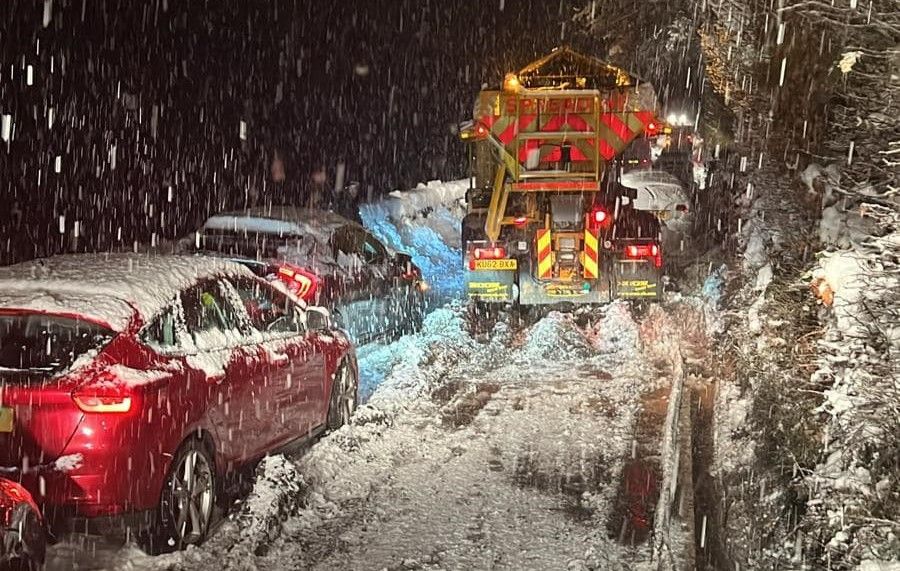
Crews worked 24/7 through day and night in 12-hour shifts to keep on top of clearing the roads as much as possible and help emergency and utility services access cut-off isolated communities. Dozens of workers were also called out to assist with the response.
Since Wednesday last week, workers across Cumbria have treated and ploughed over 2,530 miles, used over 1251 tonnes of salt and carried out over 203 hours of continuous gritting, travelling 8,230 miles.
All available gritters and ploughs were deployed on the priority roads and the weather – which caused a major incident to be declared on Saturday – created additional challenges such as abandoned cars that affected access to several roads.
The National Highways team continued to increase resources as the snow worsened and a further six heavy duty tractors, with ploughs, were deployed to some of the more difficult parts of the road network and six additional JCBs accompanied gritters in Westmorland and Furness alone.
Angela Jones, director of thriving communities for Westmorland and Furness Council, said: “It’s been a really busy few days for all involved and we really just want to say thank you to everyone who has been part of the response.
“The teams have been working around 12-hour shifts through day and night which is tough at this time of year. I’m always incredibly proud of what they do and I think particularly if you’re working in the dark and in the cold it’s total dedication to providing a public service.
“They do go above and beyond to support people, make the roads safe and support communities. We’re really proud of them and we hope they’re really proud of what they do too.
“We were also really grateful for volunteers and communities who stepped up to help neighbours and each other over the weekend.”

Cumbria police said that some highways team workers across the county received abuse from frustrated drivers as snowfall became heavier on Saturday.
Angela added: “They are on the front lines so they get the gratitude which is lovely when people say thank you and are really grateful, but they also bear the brunt of people’s frustrations as well.
“We do try to remind people that they’re just doing their job and they’re doing the best they can in very difficult conditions and to treat them with respect like you would anyone working a tough job.
“I think for people who don’t see the gritters all the time it can be easy to think they’re not there, but they really are. We have a big fleet of gritters out there and they do the very best they can.
“That’s why it’s really good to see the other side of it all and see how much effort has gone on behind the scenes because it’s easy to jump to criticism and say there’s nobody gritting or snow ploughing if you don’t it happening.
“They are trained to deal with snowfall but we were all caught out generally as the weather forecasters weren’t expecting it to escalate to such heavy snowfall and lots of drivers were caught out.
“But we were able to mobilise teams quickly once the alert was in place and tackle the priority roads.”

Angela added that roads are prioritised in Cumbria as in Westmorland and Furness alone there is over 4,300km of road networks to cover – the equivalent distance of London to the North Pole.
She said: “There is no way we would be able to grit and treat all those roads practically or financially but by Saturday night and into Sunday the majority of priority routes were passable with care.
“We had also been gritting prior to the weather event so we were prepared and we covered an immense amount of road networks as a whole county.
“It’s when you put it into numbers that you start to realise the true scale of it and all and the amount of people involved including at the council, the police and other responders like United Utilities, Electricity North West and our communities – so we just want to say a huge thank you to everyone.”
Cumberland Council said the gritting teams had been unsung heroes over the past week.
Highways teams are continuing to help clear smaller side roads where conditions remain challenging while also supporting other partner agencies such as Electricity North West to gain access to areas where power outages remain ongoing.
People who had to leave a vehicle at the weekend are now also being asked to go and retrieve them to help improve access to roads.
Councillor Denise Rollo, Cumberland Council executive member for sustainable, resilient and connected places, said: “Cumberland has some of the highest terrain and most challenging roads in the country.
“Our gritting team plays a vital role in keeping the county moving and are well prepared for whatever challenges the weather continues to bring this winter.
“It’s also very important that people exercise the same caution on treated routes as they do on non-treated roads – just because a road has been gritted doesn’t mean it is safe in sub-zero temperatures.
“The drop in temperatures and difficult road conditions presents motorists with a number of issues that make drivers, cyclists and pedestrians more vulnerable.
“The council urges road users to plan ahead of their journey for delays and poor weather conditions, and supports the advice offered by motoring authorities such as the Institute of Advanced Motorists, RAC and Department for Transport
“It is vital to ensure your vehicle is prepared for the winter and to be aware of slippery road surfaces as well as taking a supply of warm clothes and food on all journeys.”
Problems with the road network can be reported to the Highways Hotline at 0300 373 3736.