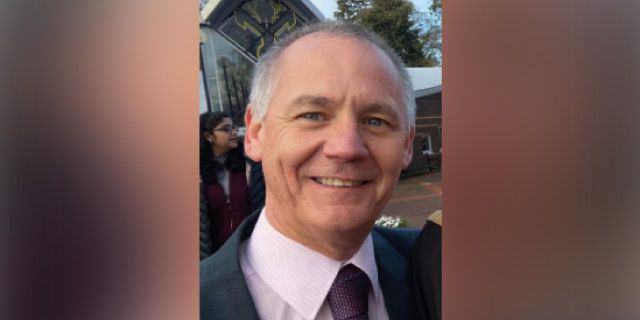
Paul Taylor’s body was burned before being hauled a matter of metres into a woodland hollow where it was hidden and lay undiscovered for several months.
Images of the scene were shown to jurors yesterday at the trial of the married father-of-two’s killer.
Jack Crawley, now aged 20, admits the manslaughter of hospital catering manager Mr Taylor, who was last seen at his family home in Annan on the evening of October 17 last year. Crawley denies Mr Taylor’s murder.
Carlisle Crown Court has heard how Crawley — a security guard at the same hospital — confessed his unlawful killing to police and led detectives to Mr Taylor’s body.
His skeletal remains were found by officers within the wildlife watcher’s haven of Finglandrigg Wood, west of Carlisle, on May 1.
Several months earlier, in late November, Natural England reserve manager Susan Woodland reported finding a burn site during an educational visit with primary school children.
She took photographs of that horseshoe-shaped area, in which a charred hi-viz item and black garment were. The black garment bore a distinctive logo matching that displayed on winter garments bought by Crawley in early October.
Jurors heard this site was yards from where Mr Taylor’s remains were found in a densely screened shallow hollow.
Both crime scenes were examined by forensic archaeologist Alistair Vannan, who presented his findings from the court witness box.
As images of Mr Taylor’s remains, including his damaged skull, were shown on court screens, Crawley did not look. Instead, in the dock, he stared ahead and slightly downwards, hands clasped, his left leg fidgeting and, at one stage, drinking from a cup of water.
Mr Vannan concluded that the main body of Mr Taylor was positioned chest down with the cranium slightly to one side. This was very close to Mr Taylor’s lower left leg which, he confirmed, appeared to have been separated from the rest of his body.
Two large branches had been placed over Mr Taylor’s body, with two saplings bent over by way of apparently further concealment and to impede access. Some more sticks covered where the skull might originally have been positioned, and others were placed over the left leg close by.
Fabric, possibly clothing, appeared to have been set alight within the burn site, in which there were numerous fragments of bone. Mr Vannan suggested Mr Taylor’s body may have been dragged into position.
Multiple bone fragments, Mr Vannan said, were missing despite police officers conducting a fingertip search of the immediate area.
Forensic scientist Linda Ainscough said this afternoon that she and a pathologist had found evidence of blunt force traumatic injuries, forceful impacts to Mr Taylor’s skull — a minimum of 10 but likely to be more. There was extensive fragmentation of bones in the cranium and lower part of the jaw. There was evidence of two forceful impacts — possibly more — to the left elbow area.
“In my opinion, the body of Paul Taylor was burned in the area of burning at Finglandrigg Wood,” said Mrs Ainscough. “At some point it was subsequently moved to the deposition site while still significantly fleshed.”
There was evidence of burning to areas of the body including the skull, shoulder blade area, right lower ribs, left elbow and both hands.
Crawley, of Sheehan Crescent, Carlisle, also denies a charge of attempted murder arising out of an alleged hammer attack on a man in North Yorkshire in early January.
Crawley is on trial with a second Carlisle man, 20-year-old Marcus Goodfellow, of Greystone Road. He denies assisting Crawley by helping to dispose of Mr Taylor’s car.
The trial continues.