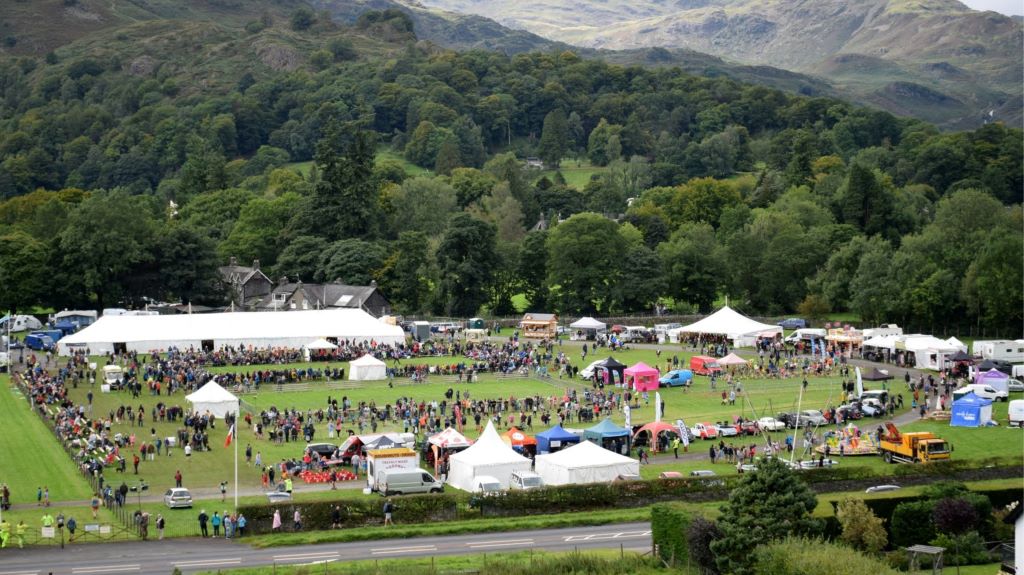
Lake District dialect will take centre stage at this year’s Grasmere Lakeland Sports and Show.
The show, on August 24, wants to demonstrate that local dialect, tradition and culture are all intrinsically entwined.
Organisers have been working with the Lakeland Dialect Society, which will have a stand at the event so people can find out more.
In the Cumberland and Westmorland wrestling ring, the sport steeped in Cumbrian heritage invites competitors to “tak hod” (take hold), as the first step in any contest.
There is also an entire poem written in Lake District dialect called Gers’mer Spooarts. The Sports has been part of the landscape since 1852, when dialect would have been far more commonly spoken.
Some words that may be heard on the field this year are unique to Lake District dialect. These include scrow, meaning ‘mess’, clarty (sticky), laik (to play) and brant (steep).
Much of Lake District dialect goes back to old Celtic speech but other words are taken from Anglo-Saxon and Scandinavian.
The Lakeland Dialect Society was founded in 1939, to foster dialect in both speech and written forms, such as verse, prose and drama. It also aims to promote the study of the area’s history and dialect used in folk lore, folk songs, local customs and traditions.
It has close links to the world of Cumberland and Westmorland wrestling and Linda Scott, the vice president of the Cumberland and Westmorland Wrestling Association, is also the society’s vice president.
The society flourished despite the Second World War and there are now around 220 members, located in places including the USA, Canada, New Zealand, Australia and China.
Although the organisation thrived, wars were one reason for a decline in the use of dialect, with people moving away and adopting standard English, to be better understood. The growth of the railways was another factor eroding the use of dialect.
Lake District dialect was formerly commonly spoken and not just in farming and rural communities but in urban hubs too.
The show is hoping to work with the Lakeland Dialect Society to produce a flyer of a few words and phrases that visitors could use.
It is also trying to get some phrases used on tannoy announcements, getting the whole crowd involved in trying to speak a little bit of dialect by saying things such as “Ah whope it aw ga’as weel” at the start of sporting events, to wish competitors luck.
John Hibbert, the show’s chairman, said: ““Whatever day out seekers are ‘laytin’, we hope to provide it, with lots of ‘hakes’ all day long, from our circus act, incredible ‘alternative’ brass band, unrideable cycles, fairground scam act and, of course, all the sporting action.
“Visitors will be ‘maffelt’ as to how fell runners reach the summit of the fell and appreciate what ‘cleggers’ they must be, especially when they see how ‘foondered’ they are on their arrival back at the finish line!
“We are a ‘menseful’ show, welcoming of everyone, not just from the local ‘nayboreed’, so we aim to give everyone a ‘larn’ day out at our ‘pill gill’, whilst also teaching them some local dialect.
“We promise people won’t have to ‘war aw thee brass’, particularly thanks to our early bird ticket prices, which are on offer until the end of June and great value.”
Dialect translation
- Ah whope it aw ga’as weel – I hope it all goes well
- Laytin – looking for
- Hakes – fun, games, entertainment
- Maffelt – baffled
- Cleggers – determined people
- Foondered – jiggered; worn out
- Menseful – hospitable
- Nayboreed – neighbourhood
- Larn – lovely
- Pill gill – outside event, sports, races
- War aw thee brass – spend all your money
- T’owd – old