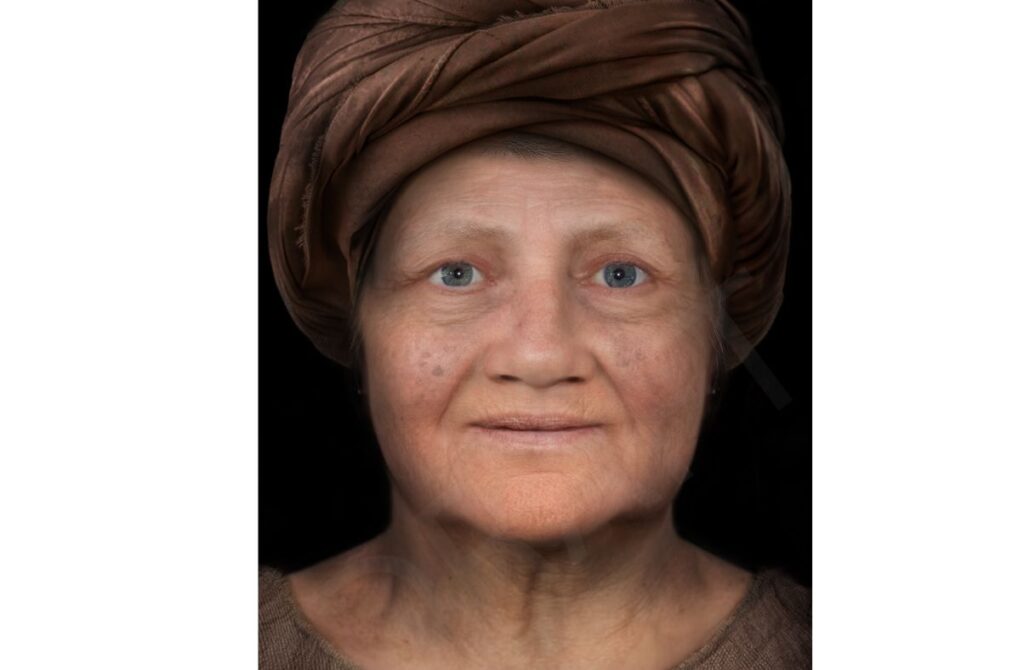
A reconstruction of how a 12th century woman in Kendal may have looked has been unveiled.
The Environment Agency has created the reconstruction based on remains found during work on Kendal’s new flood defences.
It will be officially unveiled as part of the Heritage Week exhibition at Holy Trinity Kendal Parish Church.
Fifteen articulated skeletons – skeletal remains attached at joints so that the relative position of the bones which existed in life is preserved – were lifted off-site during construction of the flood defences around the parish church.
The work also revealed the remains of a further 13 individuals at the site.
Because the bodies were beneath the churchyard wall for centuries, most of the skeletons had been crushed.
However, one woman’s skull survived in a good enough condition for scientists at Liverpool John Moores University’s forensic arts unit to rebuild it and, using computer technology, reconstruct the first image of what she looked like.
The Kendal Woman was roughly 50 years of age.
Ancient DNA extracted from her bones, and isotope analysis of her teeth suggest she had been born and probably spent her whole life living inland.
Archaeologists believe it is likely that she was born in or around Kirkby in Kendal – Kendal’s name in the 1200s – and spent most, if not all, of her life in and around the town, and could have relatives still living in the area.
The exhibition, at Holy Trinity Kendal Parish Church, will also include details of the techniques used by archaeologists working on the scheme.
Environment Agency’s senior archaeologist Stephen Dean said: “As soon as she was discovered, it was very evident she was not buried in a coffin, and was likely being laid to rest wrapped in a linen shroud.
“Her burial, on the outer edge of the churchyard, coupled with the lack of coffin suggests she occupied a lower position in the fledgling town’s social order.
“Analysis of her teeth and bones support this theory, pointing to a relatively poor diet, which comprised of grains supplemented by vegetables, fruits and (when available) meat, fish, and dairy products.
“Her bones suggest she led a hard life, and our reconstruction shows the ruddy complexion of one who has worked outdoors extensively, probably in the fields which would have surrounded the town.
“A break in her left arm points to a fall from height; this likely occurred in her youth as the fracture healed cleanly and it is not thought to have caused her issues later in life.
“What did cause her pain was chronic osteoarthritis. Her life of manual labour will have put considerable strain on her joints and this, coupled with her age and sex (women are more likely to develop osteoarthritis than men) resulted in the onset of this condition.
“We can’t say how this woman died but her age at death suggests a woman cared for, if not by family, then by church and community.
“The Church no doubt played a significant role in her life and her burial within the churchyard, even on its fringes, would have offered her the opportunity of respite in the afterlife.
“The findings have provided evidence that there has been a settlement on this site prior to the existing parish church built in 1232 AD.
“This is significant as it has been argued by historians that a settlement did exist earlier but has never been proven until now.”
The free Heritage Week display runs until September 21.
The Kendal and Upper Kent Catchment Flood Risk Management scheme, which when complete will better protect over 1,920 homes and 2,250 businesses from the impacts of flooding.