
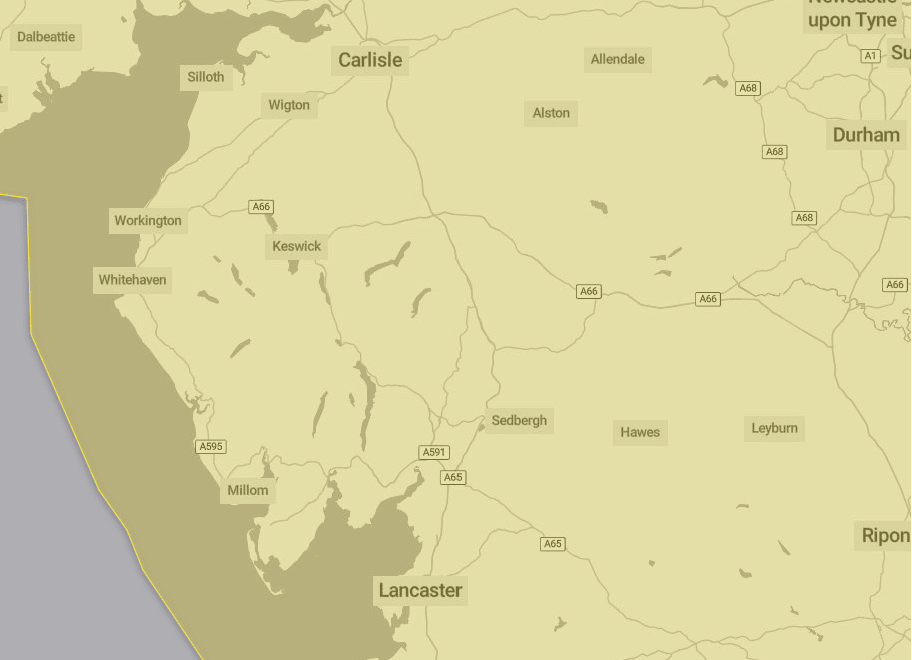
A yellow weather warning for thunderstorms has been issued for Cumbria.
The Met Office is warning that thunderstorms may cause some disruption and damage to infrastructure today, Monday August 12.
The warning has been issued from 2am to 1pm.
Forecasters said: “Thunderstorms are expected to develop over western parts of the UK and move north east during the second half of Sunday night becoming organised into Monday morning.
“Although not all parts of the warning area are expected to see them, an area of increasingly organised thunderstorms is likely to produce a combination of frequent lightning, heavy rain, hail and short periods of strong winds.
“Some torrential downpours are likely, with 20mm to 40mm in places, and a potential for 40mm to 60mm of rain to fall in one to two hours very locally, with hail up to 2cm in diameter.
“Thunderstorms are expected clear towards the north east by Monday afternoon.”
What to expect
- Spray and sudden flooding could lead to difficult driving conditions and some road closures
- There is a small chance that some communities become temporarily cut off by flooded roads
- Where flooding or lightning strikes occur, there is a chance of delays and some cancellations to train and bus services
- There is a slight chance that power cuts could occur and other services to some homes and businesses could be lost
- There is a small chance that homes and businesses could be flooded quickly, with damage to some buildings from floodwater, lightning strikes, hail or strong winds
What should you do?
Consider if your location is at risk of flash flooding. If so, consider preparing a flood plan and an emergency flood kit.
Prepare to protect your property and people from injury. Before gusty winds arrive, check to ensure moveable objects or temporary structures are well secured.
Items include; bins, garden furniture, trampolines, tents, gazebos, sheds, and fences.
Give yourself the best chance of avoiding delays by checking road conditions if driving, or bus and train timetables, amending your travel plans if necessary.
People cope better with power cuts when they have prepared for them in advance. It’s easy to do; consider gathering torches and batteries, a mobile phone power pack and other essential items.
If you find yourself outside and hear thunder, protect yourself by finding a safe enclosed shelter (such as a car).
Do not shelter under or near trees, or other structures which may be struck by lightning.
If you are on an elevated area move to lower ground.
Be prepared for weather warnings to change quickly: when a weather warning is issued, the Met Office recommends staying up to date with the weather forecast in your area.
Why are weather warnings issued?
Weather warnings are issued to let people know what weather is in store for their area and what its impact could be.
The Met Office is the UK’s official weather service and is responsible for issuing weather warnings to the public.
There are three main levels of weather warning:
- Yellow – which asks people to be prepared for disruption
- Amber – which asks people to change plans that could be impacted by the weather and take action to protect themselves and their property
- Red – which is issued for weather that poses a danger to life and asks people to immediately take direct action to keep themselves and others safe from impacts of the weather
Yellow and amber warnings represent a range of impact levels and likelihoods. This means it is important for people to read each warning to know what level of impact to expect in their local area – and how likely those impacts are to occur.
The Met Office began issuing ‘impact-based’ warnings in 2011 – which means that warnings are issued when the weather may have an impact on people’s day to day lives.
Previous to this, warnings were issued to the public when certain weather thresholds or levels were reached.
Impact-based warnings take multiple factors into account – these include time of day, if it may impact traffic, time of year, if the weather is unusual, if there are any seasonal events taking place and if the area is well equipped to deal with the weather.
Each warning level is designed to help people take steps to minimise the chances of disruption in their lives.