
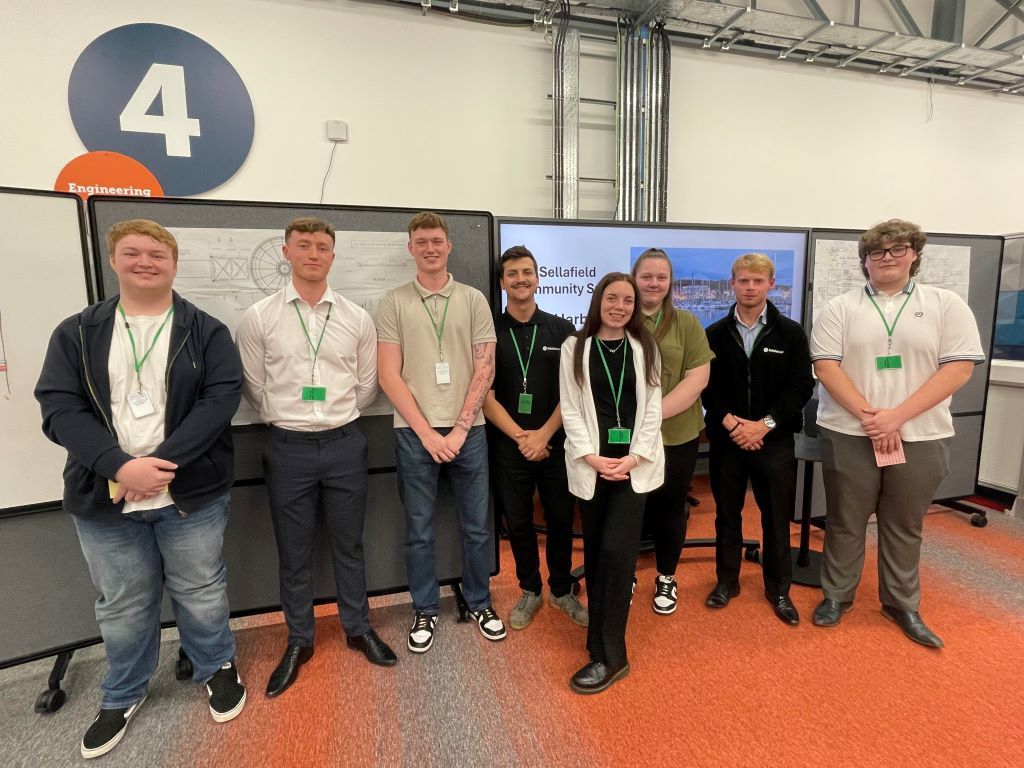
A team of apprentices, sixth formers and degree students recently collaborated on a summer sprint challenge at Sellafield Ltd’s Engineering Centre of Excellence in Cleator Moor.
The annual summer sprint challenge, now in its fourth year, brings together colleges and young apprentices and degree students from Sellafield Ltd to work on an engineering challenge set by one of the centre’s partners.
This year, the team had two weeks to devise, test and present a solution for the damaged Crow’s Nest at Whitehaven Harbour.
The results were presented to an audience of friends, family and stakeholders, including representatives from the Whitehaven Harbour Commissioners, Forth Engineering, the Centre for Leadership Performance and Sellafield Ltd.
The Crow’s Nest, is owned by Whitehaven Harbour Commissioners. Once refurbished, it hopes to use the Crow’s Nest as an events hub for weddings and community activities.
The damaged pontoon is submerged in places as the floating structure no longer supports the weight, which could potentially result in boats colliding with unseen sunken parts of the pontoon.
After visiting the site and observing the damaged pontoon, the team set up a base to discuss, plan and design ideas to provide a solution.
Following extensive discussions, which took into account the practical, environmental and safety requirements of the floating structure, the team decided that repair was not an option and that the only way to meet the WHC’s objectives was to remove and replace the pontoon.
A detailed risk assessment determined that removing the original structure was also the safest and most cost-effective solution.
The team produced three design options for the new pontoon, which utilises floating polystyrene and concrete technology to provide a robust platform for visitors to access on the surface, with a supporting structure beneath the surface that aims to support and sustain marine wildlife.
Ruby Haile, a sixth form student from Energy Coast UTC, at Lillyhall, was one of the youngest members of the team and led the presentation.
She said: “I have really enjoyed doing this project during my summer holiday and it’s definitely given me an insight into working life, and the career opportunities that are available to me right here in Cumbria. It’s also improved my confidence in public speaking and developing a detailed presentation as part of a team.”
Archie Knight, a second-year degree apprentice in Sellafield’s engineering and maintenance team, said: “This solution will meet the social, economic and environmental objectives of the challenge, stimulating tourism whilst also supporting the ecological and marine habitat for wildlife living in the harbour.”
Will Butterworth, a fourth-year mechanical engineering degree student at Sellafield, said: “Working on this challenge has been a fantastic insight into the benefits of collaborative working, improving our team-work skills and confidence.”
Craig Branney, head of off-site developments at the centre, added: “The sprint challenges are all about discovering the art of the possible, empowering young people from our local communities to devise and build a strategy for a local engineering challenge.
“This is an incredible achievement for the team, they have worked through a robust idea that meets all the objectives of the challenge they were set, and they have set a very high bar for the next cohort.
“These sprint projects help the centre understand how to identify funding, as well as create a legacy for the young people involved – when the pontoon solution is installed, they will always know they had a significant role in its design and development.
“It’s a fantastic opportunity for young people to take part in, and with the right guidance and support, they realise that anything is possible. I am extremely proud of the work they have done and look forward to the next sprint challenge.”
Mark Telford is managing director of Forth and a member of Whitehaven Harbour Commissioners. He said: “I have been really impressed by the dedication and passion shown from the young people on this project.
“They have worked together to really understand the objectives and delivered a fantastic proposal for the Crow’s Nest. It’s a huge achievement and demonstrates the level of skill and talent we have right on our doorstep.
“These guys are the future of West Cumbria’s engineering and industrial sector and I would encourage any young person to get involved with these sprint exercises, because it opens up a world of opportunity for them and future generations.”