A piece of Barrow’s history has been returned to the town thanks to a local artist.
The one-off embossed leather travel bag, which had been owned by Cumbrian industrialist Sir James Ramsden, was spotted in a Carlisle antiques shop.
Well known as one of Barrow’s founding fathers and the town’s first mayor, Ramsden’s hard-wearing piece of personalised luggage is believed to be around 150 years old.
Artist Maddi Nicholson, founder-director of Art Gene, now plans to use the portmanteau, or travel case, as part of a topical piece of performance art.
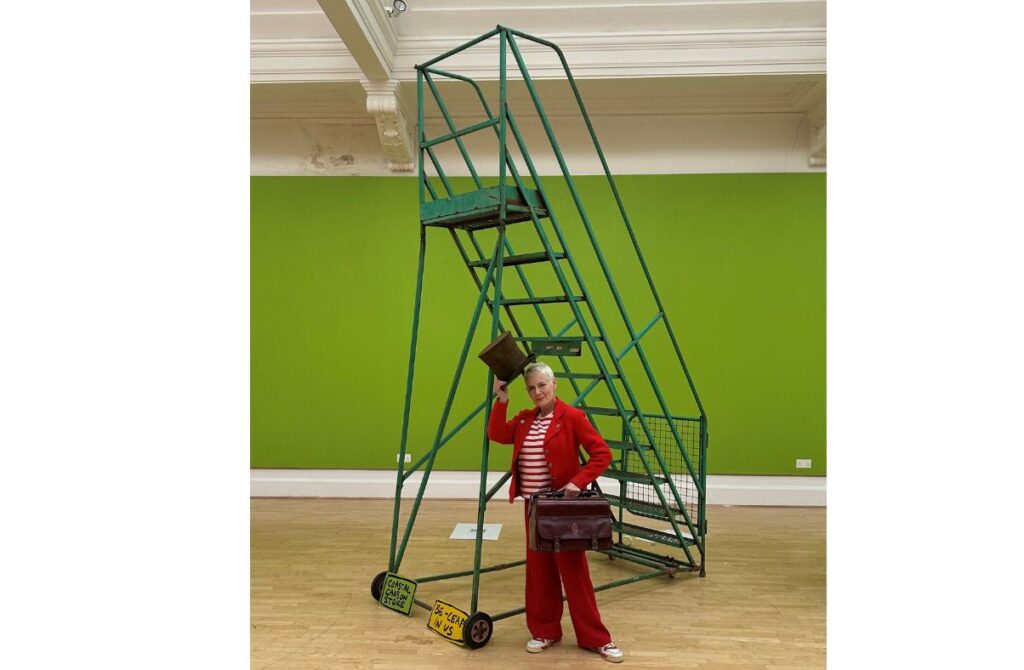
Mother Nature Mailed…She’s Mad is a one-off short performance which will see Maddi strike a series of poses atop a tall step ladder plastered with activist placards.
The piece both celebrates Ramsden and also reflects on the environmental impacts of industrialisation.
Slogans written on the placards include “May the Forest Be With You”, “Grow Your Own Soup” and “Walney Germanium Forever”, in reference to a rare plant that is only found on Barrow’s Walney Island.
During the performance, which will take place on Tuesday November 4 as part of a public exhibition launch, the artist will carry Ramsden’s portmanteau and wear a top hat similar to the one in which he was often pictured.
The performance takes place as part of an annual nationwide day of artist-led action called Remember Nature.
Remember Nature 2025 marks the 10-year anniversary of a visionary art project initiated in 2015 by celebrated artist Gustav Metzger and is delivered in partnership with 16 regional partners across England, including Art Gene, Serpentine, Tate Modern, Turner Contemporary, Manchester’s Castlefield Gallery and Baltic Centre for Contemporary Art in Newcastle.
In keeping with Maddi’s environmental ethos and eye for recycling, the artist reclaimed the platform stepladder she will use for the performance a decade ago when Homebase on Hindpool Retail Park shut down. It is a nod to the towers on which Sir James used to stand to address local crowds during his five terms as Barrow’s mayor from 1867-1872.
Maddi said she first heard about the antique case earlier in the year when Art Gene trustee Nancy McKinnel spotted it in Cathedral Lodge Antiques in Carlisle.
“I was very excited that Nancy had stumbled upon a lovely piece of Barrow’s history that had somehow ended up 100 miles away,” she said
“We knew right away that it had to come home and Nancy spoke to local councillors and to The Dock Museum, but no one could raise the necessary funds in time.
“Eventually, fearing the portmanteau might end up in a private collection far from Barrow, I called the shop myself and managed to haggle the owner down from £400 to £250.”
Maddi admitted the purchase was one of the most expensive items she had ever bought.
“I’ve certainly never spent anything like that on a handbag before,” she said. “But to me, it’s worth every penny to have Sir James’ bag back in his hometown.”
Though an admirer of everything the mechanical engineer, industrialist and civic leader achieved for Barrow, Maddi said she positioned herself as a ‘critical friend’.
She said: “I think it is important to make the connection that over 150 years later, we are now seeing the impact of the amazing industrial growth that built Barrow reflected in the climate catastrophe.
“I wanted to reflect on this, bringing together the legacy of Ramsden with nature having its say and ‘mother’ nature fighting back. Maybe I am her!”
Maddi’s performance will take place at the opening of a free exhibition called Remember Nature: Intra-action, which runs until November 18.
It brings together the work of three artists: Maddi Nicholson, Faye Matloub and Alistair Debling and explores how working peoples’ histories, colonialism and industrialisation have contributed to a disconnection from the land, separating humans from nature and the food producing environments we belong to.
James Ramsden arrived in Barrow in 1846, aged 23, as a locomotive superintendent for the Furness Railway.
He rose quickly through the company, becoming its managing director.
In 1871, he set up the Iron Shipbuilding Company, which after its 1897 sale, started to carry the Vickers name.
By 1876 it was claimed that he either owned or had a controlling interest in the majority of large companies within the town, including a paper mill, an earthenware factory, a carpet works, a chemical works, a bottle manufacturer and a jute works, which he founded in 1870 primarily as a means to give employment to the female population of the town.