A West Cumbrian charity is changing children’s lives through creative therapy.
The Windmill Trust – which has bases at Wigton Youth Station and in Workington – has been operating since 2021 to help children and young people aged five to 18 access creative therapy.
Creative arts therapy is a form of psychotherapy that uses artistic outlets like drama, painting, drawing, crafting and writing to help individuals explore and process complex emotions and trauma.
The trust works with young people who have experienced trauma through neglect, abandonment, domestic violence, abuse, separation, loss and having incarcerated parents.
It also works with neurodivergent children who have difficulty managing mainstream education and have experienced high levels of distress.
The charity is actively working to fill a gap in mental health provision for young people in West Cumbria, where it said access to long term support is limited, waiting lists are long and resources are limited.
After starting out small supporting three children, the charity has since grown and now works with 50 children and their families each year.
But it all started when Phillippa Chapman, chief executive of the charity, decided to train as a dramatherapist after working with children as an actor.
Phillippa, 48, of Wigton, has now worked with children with complex emotional issues for 17 years.
She said: “I actually first trained as an actor in London. But in between the more exciting acting jobs I was doing a lot of issue based plays in young offenders institutes, remand centres and young people’s prisons and schools.
“It was through that work that I could see the transformational power of drama and working with those young people and seeing the challenges they faced, it inspired me to train as a dramatherapist.”
Phillippa went on to set up The Windmill Trust with the support of Lesley Ritchie, the trust’s current chair, who is a play and arts therapist and runs About Children, a private creative therapy practice in Kendal.
The pair had worked together for 10 years before the idea to set up The Windmill Trust came during the first Covid-19 lockdown.
She said: “We got talking about the need for a service out west, where we could do this work.
“There are children and families here who have no way to access funding for therapy who are absolutely at risk of long-term mental health issues without support at the right time.
“So we set up in 2021 during lockdown and we got underway with delivery in 2022.
“It has grown from us initially seeing three young people with the funding we had and by 2024 we were seeing 50 children a year through one to one therapy and through small group preventative therapy.
“We do our group work in schools and work with children with high levels of anxiety, which there is so much need for at the moment.”
Phillippa said children are also generally facing new challenges in modern life, such as coping with internet use, social media and a post-pandemic world.
She added: “We do know for young people that mobile phones are a big factor in lower levels of mental health and higher levels of anxiety and the research is clear on that.
“But it also feels as though there are a lot of added pressures such as pressures on schools and teachers and fewer resources, I think it’s just a snowball effect.
“We are also seeing that children are playing less and sometimes we do see children who don’t know how to play. Everyone has become very focused on screens and it’s had quite a big impact.
“Play is how children work things through, we play for a reason and it’s really developmentally important, creativity is linked to our wellbeing.”
Phillippa said that creative arts therapy could be an essential tool to help children properly process trauma, as it allows for non-verbal expression.
She said: “I think with all the arts therapies there’s a misconception that it’s counselling with a bit of art thrown in and it’s not.
“It’s very much about working with the subconscious at a deep symbolic level, because anything we do with arts activities brings that out.
“It can give us a safe way of working things through when they’re very painful or deeply buried. Most children can’t go to therapy and just sit and talk.
“Our prefrontal cortex is not fully developed until our mid-20s and we need a way to work with children where we are working with the sensory and emotional early parts of the brain and that’s where arts therapy comes in.”
Phillippa said in West Cumbria in particular, children and young people faced some of the highest health inequality indicators in the region.
She said: “Children in West Cumbria are much more likely to be classed as a child in need, they’re much more likely to be living in poverty and have experienced four or more adverse childhood experiences.
“Around West Cumbria there are pockets that are within the 15 per cent most deprived areas of the country. Alongside that there’s a lot of trauma and high level need that can be invisible almost or go unnoticed.
“In other parts of the country they do have arts therapy departments but that’s not something we get in Cumbria because our resources are so stretched.
“It’s no fault of our services like Child and Adolescent Mental Health Services (CAMHS), it’s that we just don’t seem to have the resources here.
“So there’s a huge level of need and a huge amount of work to be done in order for people in West Cumbria to have the same access to resources they might have elsewhere.”
The Windmill Trust is made up of a small team and takes on new children and families when a space comes available.
This is done through referral from partners like schools, social prescribers and CAMHS.
She added: “The young people we work with have typically already tried lower level services. They often have a time limit and they need more or they’ve had input from CAMHS crisis team, but they don’t meet the criteria for continued support with CAMHS.
“It’s that middle space where there’s a bit of a gap and we fill that need. There’s so many children that need long-term support, but CAHMS are under so much pressure and there’s lots of children who don’t meet its threshold.
“There also isn’t many places where children can access arts and play therapies, very few places can offer it.
“We’re also really passionate about working with families because I don’t believe you can always work with children in isolation. There are parents who’ve experienced their own trauma and it’s important to work with the family and support everyone in that unit.”
Unlike traditional counselling, creative therapy sessions at The Windmill Trust have no set outline or approach.
Sessions focus on building trust between the child and therapist, while giving children a creative space to express their experiences, emotions, thoughts and feelings.
The sessions also focus on helping children improve emotional literacy, self‑regulation, and build positive relationships with themselves and others.
For families, the charity also provides guidance, reassurance and support to help parents better understand their children.
Phillippa added that for some children who’ve experienced trauma, building enough trust to express themselves can take up to three years.
She said: “The first phase of therapy is always about us building a safe therapeutic relationship and getting to know what creative tools will this young person want to use.
“So although I am a dramatherapist, that doesn’t mean that every young person who comes to see me does drama.
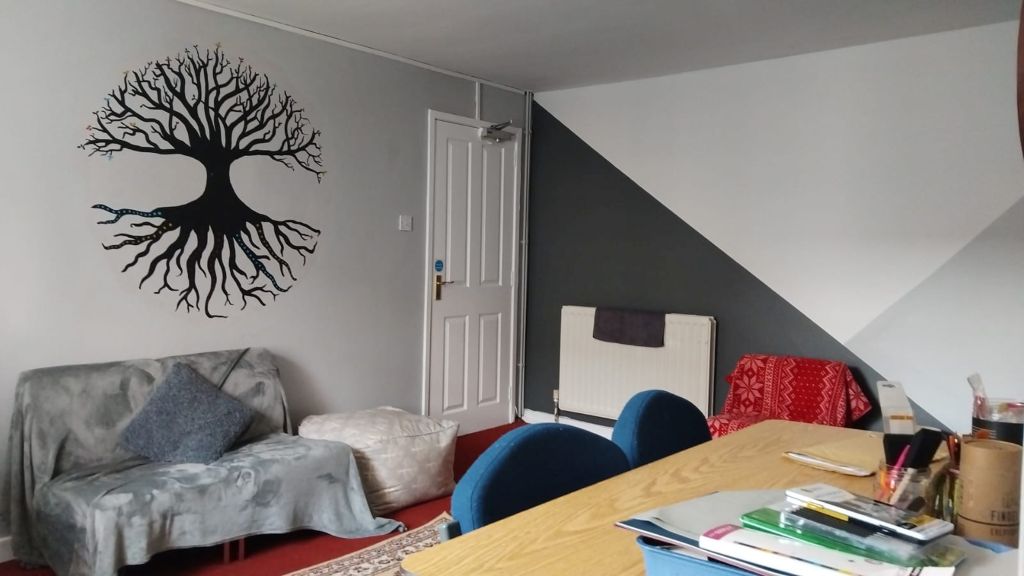
“In the room with us we have a huge range of creative materials and toys so they can see what they’re interested in doing.
“But if a teenager wants to just come in, sit and talk, we of course let them. We are young person led.
“It’s only when that therapeutic relationship is right and they fully understand what they can use the space for, that you then start to see what they’ve experienced start to come out.
“That can be through a play, or artwork, or through what they create or write.”
The trust was also recently selected as one of just 10 organisations across the UK to join the 2026 GSK Community Health Programme, delivered in partnership with The King’s Fund.
The programme is helping the charity access different avenues of funding and support as well as a specialist leadership development programme – all of which is helping it to continue its work in West Cumbria.
Phillippa said: “We’re incredibly thrilled to be part of it, it’s all about addressing health inequalities and I feel that is so important for West Cumbria.
“It’s wonderful to be part of a cohort of other really small new charities across the country because what also came with it is the leadership programme and it’s been such a vital support to us as a small charity.
“It is difficult sector and funding is very competitive so we just feel absolutely blown away to be one of the lucky charities to get that.”
Phillippa said that families often describe having access to The Windmill Trust’s creative therapy as life-changing.
She added that families have also said it has helped their children re-engage with education, improve family relationships and regain hope for the future.
She said: “I’ve had parents say things to me like you’re the only ones who have understood. You see children who have been exhibiting things like violent behaviour beginning to calm down and parents saying they now finally understand their child’s behaviour.
“Because we provide that theraputic relationship to the whole family, one thing we’re really passionate about is we will be there until the reasons for the referral are no longer there.
“We’re not time limited, we will work with people for as long as it takes.”
The Windmill Trust is a charity that relies entirely on donations to run. You can donate to support the trust here.