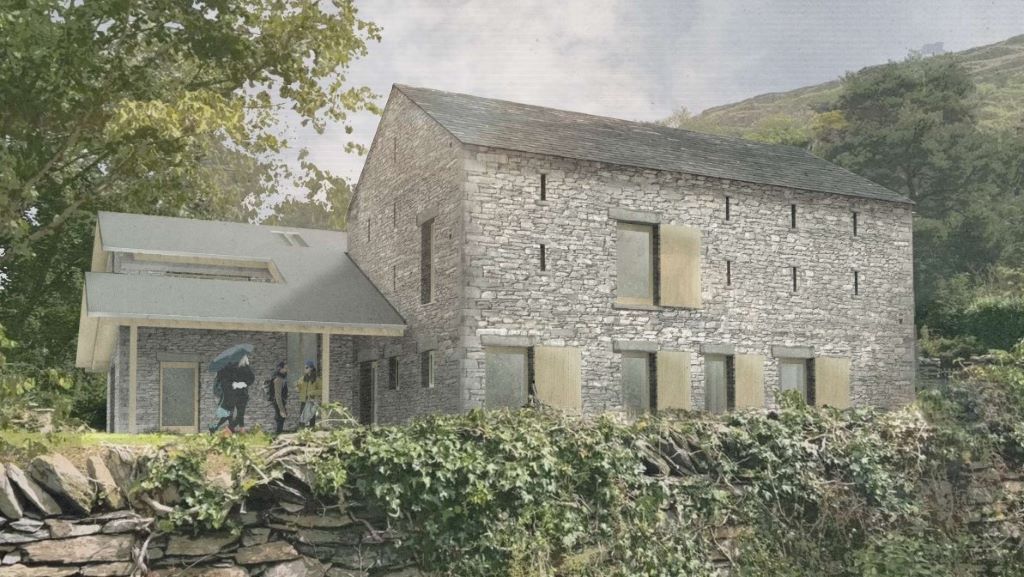
A Lake District barn is set to be turned into a community hub.
Alex Knapp applied to the Lake District National Park Authority to convert the empty Nibthwaite Barn, High Nibthwaite, near Ulverston, into a hub for the village, the growing arts community of Crake Valley and for artists, makers and performers.
The application said the Knapp family had been connected to Nibthwaite for more than 130 years.
It said: “There are now 10 families of cousins, aunts and uncles who either live in Nibthwaite or pass through regularly. For all of us, it is a place of important memories and life experiences.
“The village has many interesting people but no public space, no gathering place. When this barn came up for sale after many decades of limited use, it presented a great opportunity to create something that has never existed in the village.”#
It said a new charity was being established to fund the ongoing operational costs of the barn and a live-in warden.
The barn will include a sprung dance floor and it is hoped it will be used for village events, craft workshops, wellbeing events and by visiting theatre groups.
As well as the change of use, the application was also for an associated extension, infrastructure and landscaping at the 0.145 hectare site.
The application has been approved, subject to a number of conditions, and the project includes the provision of 15 parking spaces.
According to a planning statement the site is in the Crake Valley at the south eastern end of Coniston Water within the Lake District National Park.
It is bounded by a public road which runs along the eastern shore of Coniston to the south and a private access road used by local residents to the north.
The village of Water Yeat is 1.5km from the site, to the south west, and the report said: “Centrally located in High Nibthwaite, the site is a focal point within the village and is connected to an area of common land to the west and is used by local residents.”
The report said that several footpaths leading to Brock Brow to the east and the village was not served by public transport but the nearest bus stop is on the A5084 at Water Yeat.
Currently the site has no utility connections but it has previously had connections to water and power.
The report said that the barn, thought to date back to the industrial 1840s, is formed of stone walls with lime mortar, timber trusses and what is described as “a diminishing slate roof”.
It added: “The barn is not insulated and has remained empty since it ceased to be used for agricultural purposes more than 20 years ago.
“The barn is generally in good condition. The upper floor is well proportioned with a generous high floor to ceiling height and is ideally suited as a gathering/small performance space.”