
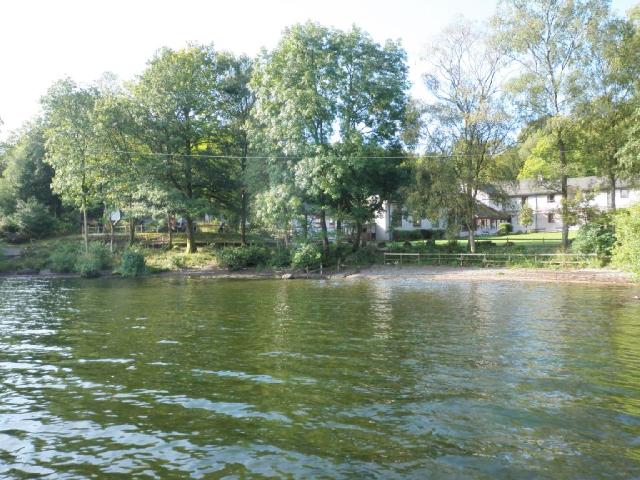
People have been urged not to bathe in Windermere due to potential pollution from harmful algae.
Defra said it the area around Lakeside YMCA on the western edge of the lake in the south basin was affected.
There is a risk due to a potentially toxic bloom of blue-green algae.
It is a shallow sloping, shingle and gravel beach with broadleaved woodland to the water’s edge in places.
The Environment Agency said on May 21, it received a notification via the Bloomin’ Algae app of a suspected bloom.
Campaign group Save Windermere said: “We’re constantly being told Windermere’s bathing waters are of excellent quality.
“But one of Windermere’s four official bathing sites was marked as bathing not advised.
“We have long warned that these bathing water classifications offer a false sense of security due to how the analysis is undertaken, how often the sites are sampled and what the Environment Agency looks for.
“The current system measures only E. coli and enterococci bacteria, but fails to account for harmful algae.
“In its natural state, Windermere would be classified as oligotrophic, meaning it should naturally be so low in nutrient that algal blooms would be incredibly unlikely or infrequent, or would not occur at all.
“This is why Save Windermere is calling for a complete end to sewage pollution in the lake as this is the biggest contributor to the algal blooms we see.”
An Environment Agency spokesperson said: “We are aware of the presence of blue-green algae in Lake Windermere at the Lakeside YMCA bathing water.
“As a result, the current advice is to avoid swimming in this part of the lake.
“Blue-green algae is a naturally occurring environmental phenomenon. It is not unique to Windermere and can appear in many water bodies across the UK, particularly during warm, calm, and dry conditions.”
It added once it was notified, an Environment Agency officer was deployed, and a sample was taken to confirm the presence of blue-green algae.
Following confirmation, riparian land owners and relevant authorities were notified and the information was uploaded to Swimfo.
A follow-up sample will be taken next week to assess whether the bloom has dispersed.
It added: “Bathing Water sampling by the Environment Agency tests for gut bacteria/faecal indicators/E.Coli and Intestinal Enteroccocci.
“It does not routinely test for blue-green algae, however, if samplers observe a bloom they will sample and have this analysed. If a bloom is confirmed, this information is provided together with the bathing water sample results on Swimfo.”
Earlier this month, Derwentwater’s water quality was designated as officially poor.
Derwentwater at Crow Park in Keswick has undergone its first full year of monitoring by the Environment Agency since it was granted bathing water status.
People are encouraged to report possible blooms direct to the Environment Agency on 0800 80 70 60 or via the UK CEH Bloomin Algae app. This enables samples to be taken and analysed and landowners informed to erect signs.
Before entering a bathing water, the Environment Agency strongly recommends that people check Swimfo for up-to-date information.