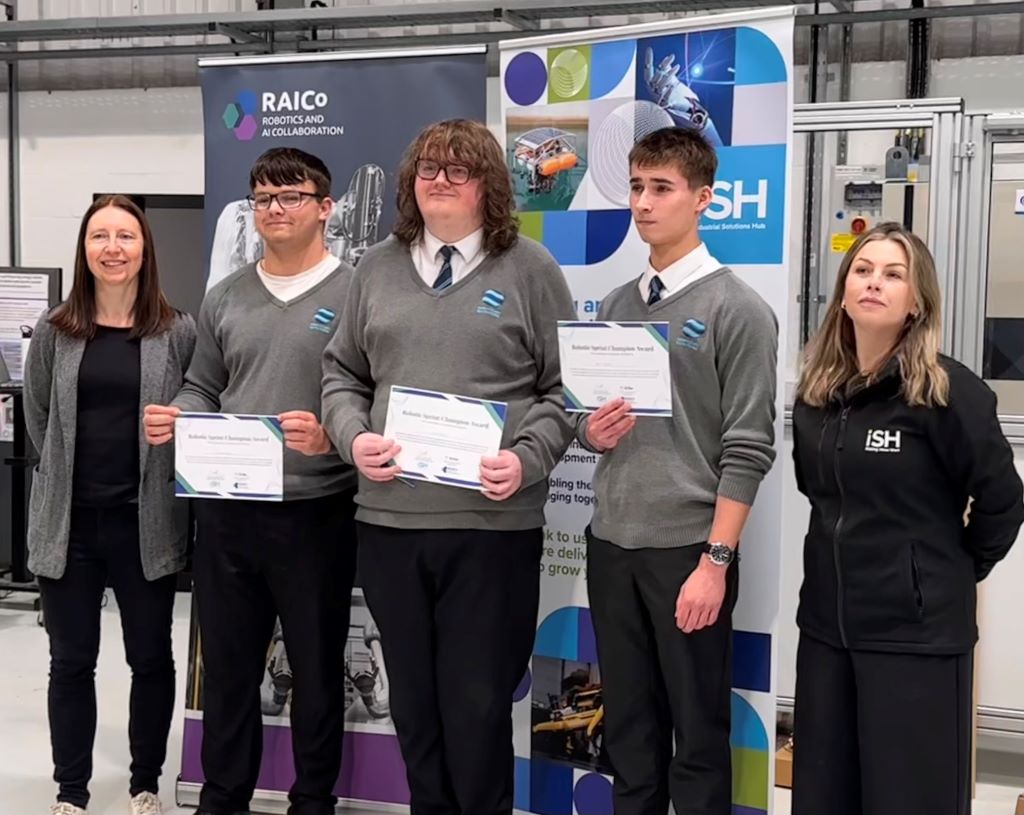
A team from the West Coast Sixth Form Centre won the final of a robotics school sprint challenge.
It was held at RAICo1, the facility of the Robotics and AI Collaboration in Whitehaven and was the final stage of the six-week Robotics Sprint schools challenge – a collaboration between RAICo and the Industrial Solutions Hub (iSH).
Alongside teams from Energy Coast University Technical College, and Lakes College West Cumbria, Alex Bell, Sam Parr and Charlie Bell from West Coast Sixth Form have spent the last six weeks designing, building, and programming small robots to complete a mock version of a real-world nuclear challenge.
All participating students are studying for A-levels and T-levels in fields like cyber security and digital.
They were tasked with gathering high hazard waste barrels from a hot cell area and moving them to the storage area.
To do this, students created a claw attachment for their robots and programmed them to move while avoiding any obstacles.
For the final event, the students presented and demonstrated their solutions to an audience of judges, industry delegates, and educators, reflecting on the brief, sharing their experiences, and highlighting the technical and soft skills they developed throughout the programme.
The winning team said: “”We’re thrilled to have won, especially as we weren’t expecting it from the start. It was rewarding to see the progress we made throughout the challenge put into practice and to see our effort lead to success.
“One of the most enjoyable aspects was the competitive element and the opportunity to visit RAICo1, where we could see the future of robotics and compare different robots.
“The experience taught us that disagreement is an important part of teamwork, and that discussing different ideas helps a team decide what to do next.
“We also gained a better understanding of what happens behind the scenes to make robots work. The transferable skills we developed will help us in the future across different pathways, including mathematics and robotics.”
Now in its third year, the initiative has been so successful that it has been officially recognised by the Skills Builder Partnership – a UK organisation that promotes essential skills development – as achieving Impact Level 4, its highest rating.
The accreditation recognises programmes that demonstrate a clear framework for skills development and evidence of impact in education and employer engagement.
Hollie Johnston, project manager at RAICo, said: “Initiatives like the Robotics School Sprint Challenge are vital delivering positive local impact and maintaining Cumbria’s role as a centre of innovation and investment.
“By educating and inspiring young people about the expanding range of nuclear opportunities on offer, building their skills and confidence in using new technologies, and connecting them to those already doing these jobs, the programme ensures a pipeline of future talent and skills, promoting future growth.
“Once again, we were blown away with the students’ ingenious robots and enthusiasm throughout the challenge.”
Hannah Pears, skills lead at iSH, added: “These young people, and others like them, are the key to future innovation and investment in Cumbria, as well as delivering impact at a national level.
“Following this year’s challenge, I am confident we’re in good hands. The students’ teamwork, and problem-solving skills have been fantastic to see and by giving them valuable hands-on experience and insight into future career opportunities, the programme has strengthened the future workforce for local companies across the Cumbria Robotics Cluster.”